
The Loss of Light Vessel 82

Huge gray waves still swept out of the darkness to meet the long steel hull of the ore freighter Champlain, but the worst was over now. Snow and spray no longer rattled like buckshot off the pilot house windows, and the scream of the winds had died almost to a whisper. First Mate Herbert Dupuie had the watch, thankful that the November gale had almost blown itself out. Lake Erie was still a wild expanse of churning waters, but the 80-mile-an-hour winds that had blown the tops off mountainous seas had died away and the heavy snows were past.
- Read more about The Loss of Light Vessel 82
- Log in to post comments
Point Sur: Lighthouse Memories

We arrived at Pt. Sur Light Station on March 11, 1935. At that time, our family consisted of my husband Bill, myself and our five children: Shirley-seven, Sarah-six, Dixie-three, and the year-old twins, Jean and Joan. The ride was not nearly as long as our ride from San Francisco to Pt. Conception Light Station, where Bill began his service. The road from San Luis Obispo was unfinished and we had to circle around through Monterey and south to Pt. Sur, travelling partly on Highway 1 and partly on Highway 101. We had been expected, so the station gate was unlocked.
- Read more about Point Sur: Lighthouse Memories
- Log in to post comments
Point Sur
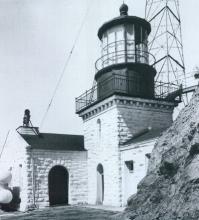
The coast of California sweeps along a giant curve for nearly 1,000 miles. It is dimpled with very few harbors of refuge and punctuated with a few promontories which mariners have bumped into over the years. For much of the summer months the intercoast is enveloped in a dense fog. This climatic condition, coupled with prevailing winds and currents that set vessels to the southwest, and onto the coast, has caused countless shipwrecks. It was especially so prior to the 20th century, during the age of sail and before electronic navigation devices.
- Read more about Point Sur
- Log in to post comments
Chatham: Cape Cod's Second Lighthouse
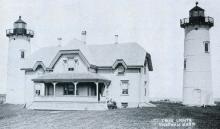
The history of Cape Cod's second lighthouse is (as was with the first at Highland) that of encroaching seas. Since 1808 its position has twice retreated before winter storm induced erosion. The next logical location for a lighthouse on Cape Cod, after the Cape Cod station at Highland, was along the Chatham shore. A light at this location would assist mariners make the passage from Nantucket Sound around the cape.
- Read more about Chatham: Cape Cod's Second Lighthouse
- Log in to post comments
Big Bay Point Lighthouse – Pages from the Past
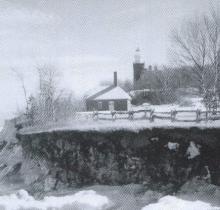
The year 1897-
Nov. 11 - Keeper left station at 11 am to go to Marquette on foot being called by message to the deathbed of his only sister and remaining until after the funeral.
- Read more about Big Bay Point Lighthouse – Pages from the Past
- Log in to post comments
Roman Lighthouses
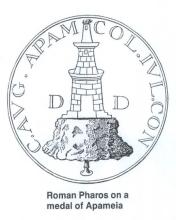
The first crude beacons to serve as lighthouses, in what is now Italy, were probably constructed during the heyday of ancient Greece. Before the rise of the Roman Empire the Greeks traded heavily with the colonies of the southern Italian peninsula and Sicily. However, we only have documentation of lighthouses in Italy from Roman times. Evidence comes from the writings of the Roman historian Pliny, bas reliefs, coins, decorations on vases, mosaics and even sarcophagi.
- Read more about Roman Lighthouses
- Log in to post comments
Horseshoe Reef Lighthouse
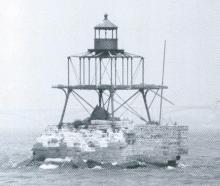
Not one in a hundred Buffalo area sailors today could name the spidery metal framework that guards the entrance to the swift flowing Niagara River and marking the eastern end of Lake Erie. Fewer still would identify it as a place where men once lived and worked, lost in desolate solitude between two nearby cities. Long neglected and derelict, the offshore relic is seldom visited. Even local Coast Guard personnel, stationed within sight ofthe black iron platform, would be hard pressed to tell the casual visitor its history. No one visits, save the seagulls.
- Read more about Horseshoe Reef Lighthouse
- Log in to post comments
The History of the Administration of the U.S.L.H.S. (Part 1)

The first colonial American aid to navigation, of which we have firm evidence, was the beacon erected at Nantasket (now Hull) Massachusetts in 1673. The beacon was a small stone tower erected at Point Allerton, a promontory guarding the south approach to Boston Harbor. The citizens of that community provided funds to furnish "fier-bales of pitch and ocum" in an iron basket surrounding the small beacon.
St. Augustine Lighthouse

Inspired by West Indian tales of gold and a fountain giving perpetual youth, Juan Ponce de Leon, Spanish Governor of Puerto Rico, reached Florida's eastern shore on April 2, 1513. He landed between (what are now called) the St. Augustine Inlet and the St. John's River. He claimed the land for Spain and named it "La Florida", land of the flowers. In 1564 when French Huguenots established Fort Caroline, five miles from the mouth of the St. John's River, King Philip of Spain sent Pedro Menendez de Aviles with an expedition against the colony.
- Read more about St. Augustine Lighthouse
- Log in to post comments
Longships Lighthouse
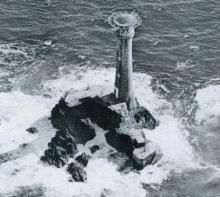
A round the cliffs of Land's End, at the extreme south-west point of the British mainland, there is displayed during storms a wild panorama described by John Ruskin as an "entire disorder of the surges...the whole surface of the sea becomes one dizzy whirl of rushing writhing tortured undirected rage bounding and crashing and coiling an anarchy of enormous power". The headland is encircled by rocks on which countless ships have been lost in heavy seas or during poor visibility.
- Read more about Longships Lighthouse
- Log in to post comments