
The Lost Otter Creek Point Lighthouse

In the very southeastern corner of Michigan is where the second lighthouse in that state stood. It was one of the earliest lighthouses built on Lake Erie. I ran across a mention of this lighthouse some years back and wondered just where it was located and why it was built. I found that the lighthouse stood for a little less than 20 years and very little was known about it. So, I decided to see if I could discover some of its history. The story you are about to read will give you all I have been able to find about the lost Otter Creek Point Lighthouse.
- Read more about The Lost Otter Creek Point Lighthouse
- Log in to post comments
Lighthouses of Chicago Harbor
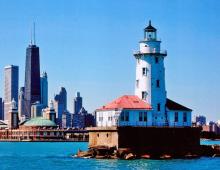
It is difficult to imagine a time when the banks of the Chicago River were lined by scores of tall-masted schooners and steamships. Yet, for the last half of the 19th and into the early 20th century, this river, which trisects the City of Chicago, was home to port operations that made this Midwestern metropolis one of the most commercially important cities in North America. In fact, the historic port of Chicago with its weather-shortened, eight-month shipping season frequently had more arrivals and departures than the year-round ports of New York, Boston, and San Francisco.
- Read more about Lighthouses of Chicago Harbor
- Log in to post comments
Little Traverse Lighthouse
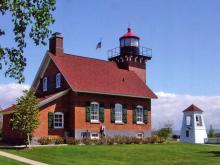
From the earliest days, the northern Lake Michigan shoreline stretching 30 miles south of Waugoshance Point represented an area of incredible natural bounty. It had an endless supply of wildlife and fertile soil. By the 1600s the area supported one of the largest Indian populations to be found anywhere in North America.
- Read more about Little Traverse Lighthouse
- Log in to post comments
Gull Rock: A Little Lighthouse with a Big History (Part 1 & 2)
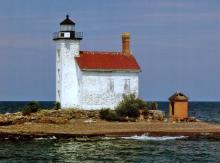
Gull Rock is a small island roughly the size of a football field consisting of conglomerate bedrock covered with a sprinkling of glacial till [the sediment deposited by a glacier]. The island sits in the open waters of Lake Superior and rises roughly 12 feet above the surface of the lake. As the name implies, Gull Rock is a well-established nesting area for gulls. Other than lichen and a few hardy crevice-borne bushes and plants, the rock is devoid of vegetation or even much topsoil.
The Little Known Lighthouse of New Buffalo, Michigan: Only Yesterday

The opening of the Erie Canal in 1822 brought the outside world to the Great Lakes. The huge increase in vessel traffic dictated the establishment of lighthouses and other aids to navigation. But in that era, with Stephen Pleasonton in charge of our aids to navigation system, the placement of aids was not always done in a logical manner. Some were established for political reasons, others in response to a "squeaky wheel."
Constructing Rock of Ages Lighthouse: Tinkham Tales
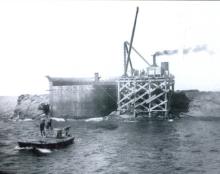
Over fifty years before the opening of the St. Lawrence Seaway (1959), I was building lighthouses and related engineering projects in some of the most isolated regions of the Great Lakes and along their connecting waterways.
History of the Monroe Lighthouses, Monroe, MI: Only Yesterday
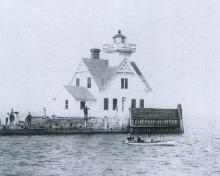
Sailors have often found Lake Erie to be the most challenging of the Great Lakes. Its shallowness can cause violent waves, especially during turbulent weather. On May 23, 1828 Congress authorized the Secretary of the Treasury to build a lighthouse on the west end of Lake Erie at a place known as Otter Creek Point in Monroe, Michigan. The decision came after years of pleas from residents, including Monroe's first newspaper editor, Edward D. Ellis.
White River Light Station

The western edge of the stateof Michigan was a lush, densely wooded area in the early 1800s. The land was covered by a massive forest of pine and hemlock, and lesser numbers of hardwood trees such as maple and oak. In 1838, Charles Mears built the first sawmill on White Lake, approximately six miles east of the old White Lake Channel to Lake Michigan. This mill used water power cut logs into high grade pine planking. Charles built several mills in the area in the following years, some of which also produced wooden shingles.
- Read more about White River Light Station
- Log in to post comments
12 Children On A Rock In Lake Superior: Menagerie Island

We were sitting around on the grass-upholstered rocks of Menagerie Island, sailors from the lighthouse tender Marigold and I, talking of this and that, and watching the ship drifting about in Siskiwit Bay. The sailors were waiting for a bo'sun's chair so that a man could be lowered from the top of the automatic light to make certain repairs.
The Building of the Detroit River Light Station
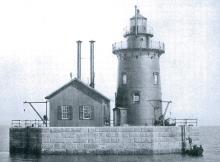
The vast majority of Great Lakes water borne commerce passes through the Detroit River. There was no busier shipping period than the last quarter of the 19th century. Vessels heading west from Buffalo navigated across shallow Lake Erie and then swung north into the very narrow Detroit River. The Detroit River is a swift running river that empties into the northwestern comer of Lake Erie dumping alluvial deposits that form narrow, shifting channels.