The Inalienable Lighthouse Lens of Ferndale, California

At the great northern elbow of California, in the days when the state's entire coastline was yet "lost," a stocky little lighthouse shouted a powerful warning to the Pacific. It is the great Fresnel lens of this lighthouse that is the subject of this narrative. On December 1, 1868, the 16-sided Cape Mendocino Lighthouse began to signal one white flash every 30 seconds by way of a slowly rotating, 16-sided first-order Fresnel lens manufactured by L. Sautter et Cie of Paris, France. The tower stood on top of a concrete-filled hole dug into rock at 425 feet of elevation.
Los Angeles Harbor Light: The Angels Gate Lighthouse

Los Angeles Harbor Lighthouse, with its distinctive green flash, has stood at the entrance of Los Angeles Harbor for nearly 100 years. Located at the end of the two-mile federal breakwater, the tower has withstood numerous earthquakes, a tidal wave, and the impact of both curious visitors and vandals. The lighthouse is the welcoming icon for recreational boaters, cargo carriers, and passenger ships arriving at the nations busiest container port. Ironically, despite its high profile, the history of the L. A. Harbor Lighthouse has never been thoroughly researched.
Patronage, Politics and Preferences: Pt. Fermin Lighthouse Keeper Mary Smith's Truncated Career

The access road to the Point Fermin Lighthouse in San Pedro, California runs through a heavily utilized urban park maintained by the City of Los Angeles since the 1920s as a green and breezy oasis for inhabitants of the crowded Los Angeles Harbor region. Any weekend visitor who sees the number of joggers, babies in strollers, Frisbee throwers, picnicers and other recreational users the park accommodates on a weekend, under a canopy of ancient-looking Moreton Bay Fig trees, will have a hard time imagining that the Point was once a remote and isolated desert wilderness.
Fort Point San Francisco Bay, Only Yesterday
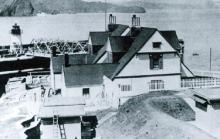
When the first eight lighthouses for the west coast were authorized in1850, three were designated for the San Francisco Bay area: the Farallon Islands, Alcatraz and Fort Point. After some controversy, the contract was awarded to Baltimore, Maryland firm and a ship set sail for the west coast. By 1852, workhad started on the lighthouses. A single design of a Cape Cod-style building with a tower through the middle was selected.
- Read more about Fort Point San Francisco Bay, Only Yesterday
- Log in to post comments
Point Arena Lighthouse and the 1906 Earthquake

The California earthquake of April 18, 1906 ranks as one of the most significant earthquakes of all time. Today, its importance comes more from the wealth of scientific knowledge derived from it than from its sheer size. Rupturing the northernmost 430 kilometers of the San Andreas Fault from northwest of San Juan Bautista to the triple junction at Cape Mendocino, the earthquake confounded contemporary geologists with its large, horizontal displacements and great rupture length.
- Read more about Point Arena Lighthouse and the 1906 Earthquake
- Log in to post comments
East Brother Light Station: Saved

After World War II, Coast Guard personnel replaced civilian keepers at East Brother. Their duties, though remained much the same as those of their predecessors. They tended the station around the clock, watching over the light each night and, when necessary, operating the diaphone. There was still the work of cleaning the lens, checking the backup systems, doing painting and other routine maintenance work, and regularly ferrying groceries and supplies from shore to the island.
- Read more about East Brother Light Station: Saved
- Log in to post comments
Mile Rocks Light Station San Francisco Bay, CA: Only Yesterday
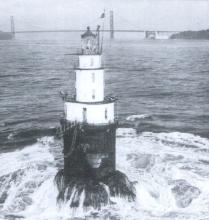
In 1878 the Pacific Mail Steamship Company luanched their City of Rio de Janeiro. She was an iron-hulled vessel with a length of 344 feet and built for service, and certainly no beauty. Her main mission was hauling cargo and passengers between Asia and west coast ports. In January 1901, the Rio, fully loaded with passengers and a cargo of silk, rice and tea, departed for San Francisco. With 79 suecessful voyages to her credit, this, her 80th, would be her last. The crossing was particularly rough and most of the passengers were sick.
St. George Reef Lighthouse: A Nineteenth Century Engineering Feat
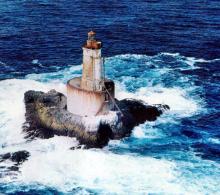
St. George Reef is made up of a series of rocks, pinnacles, and small islets extending into the Pacific Ocean about eight miles from Point St. George in northern California near the Oregon Border. Some of the obstructions are submerged and some are above water, depending on the stage of the tide. The area has long been a critical turning point for vessels navigating along the West Coast. Coastal navigation continued to increase as the West Coast developed after the Gold Rush, which began in 1849. But lighthouse construction was halted during the Civil War.
Growing Up at the Humboldt Bay Fog Signal Station: Lighthouse Memories
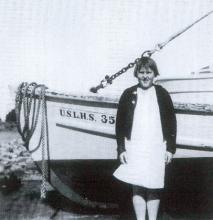
It was around the latter part of January 1932, my dad, T. J. Allen, told my mother, Martha, and me that we were going to move to northern California. He had been accepted into the United States Lighthouse Service as a 2nd Assistant Keeper [at the Humboldt Bay Fog Signal Station]. Prior to this, as far back as I can recall, he was chief engineer on the Southern Pacific Ferry boats that ran between Oakland and San Francisco before the Bay Bridge was built.
Table Bluff Light Station, CA: Only Yesterday
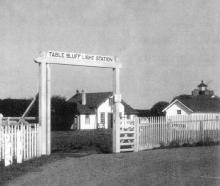
The 1909 Coast Pilot describes Humboldt Bay as, "...the first important harbor north of San Francisco... a large amount of redwood lumber is exported to foreign [ports] and shipped to domestic ports; there is also a considerable amount of farm and dairy produce, most of which is shipped to San Francisco. Since the improvements by the Government this harbor can be used as a harbor of refuge in impending bad weather provided it can be made [entered] before the bar [channel] becomes impassible." An early Coast Pilot stated that the entrance was "...dangerous to strangers... "
- Read more about Table Bluff Light Station, CA: Only Yesterday
- Log in to post comments