Execution Rocks Lighthouse
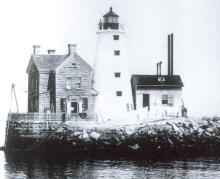
Several legends surround a low-lying reef at the eastern end of Long Island Sound. Exposed at low water, the reef is not visible during periods of high water. Over the years, early settlers to the area said that local Indians tied their enemies to the rocks at low tide, drowning them when the tide came in. The same story was repeated in later years, only with the British chaining captured colonialists to the rocks during the American Revolution. Of course, the tales have never been substantiated.
- Read more about Execution Rocks Lighthouse
- Log in to post comments
The Oswego West Pierhead Lighthouse
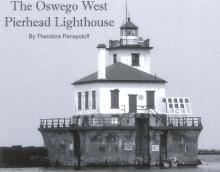
In 2009 the City of Oswego, New York, acquired the Oswego West Pierhead Lighthouse under the provisions of the National Historic Lighthouse Preservation Act Of 2000. Restoration work has begun using seed grant from the New York State Canal Corporation under management Of the city's Oswego Lighthouse Development Committee in partnership with the H. Lee White Marine Museum of Oswego.
- Read more about The Oswego West Pierhead Lighthouse
- Log in to post comments
The Lighthouse at West Point Military Academy

Long before cities and ports were established along the Hudson River's twisting 315-mile route from the Atlantic Ocean to its source in the Adirondack Mountains, its strategic value was recognized. Henry Hudson, for whom the river is named, sailed along the shores of present-day Manhattan in September 1609 seeking the fabled Northwest Passage. His voyage, which took him as far north as the area around Albany, was financed by the Dutch East India Company.
- Read more about The Lighthouse at West Point Military Academy
- Log in to post comments
The Huntington Harbor Lighthouse: Long Island's Offshore "Castle"

The story of the Huntington Harbor Lighthouse (originally known as the Lloyd Harbor Light Station) is that of two very different lighthouses at two different locations, serving somewhat different purposes. It is also a story of the evolution of lighthouse design and of the result of hard work and dedication in historic lighthouse preservation.
Coney Island Light Station, New York

Coney Island, now a peninsula attached to the mainland, was formerly the weseternmost of the barrier islands off New York's Long Island. The island was named for its once teeming rabbit population; coney is an old word for rabbit. A bill "to establish lights at the western end of Coney Island," known as Norton's Point (after a nineteenth-century politician who once ran a hotel at the point), was introduced in Congress in 1888. J.O. Coleman, New York City's commissioner of street cleaning, urged passage of the bill in a February 1889 letter to New York's representatives in Congress.
- Read more about Coney Island Light Station, New York
- Log in to post comments
Old Field Point Light Station Long Island, NY

The Old Field Point Lighthouse stands atop a bluff about 50 miles east of New York City and two miles west of the entrance to historic Port Jefferson Harbor on Long Island Sound. Although it is one lesser-known of the 15 standing lighthouses in Suffolk County (the county in the United States with the most lighthouses), its place in history and as a historic site stand out on several accounts.
- Read more about Old Field Point Light Station Long Island, NY
- Log in to post comments
Eatons Neck Light Station, Long Island
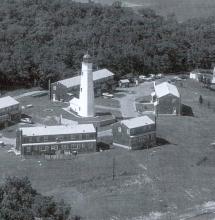
Eatons Neck Lighthouse, situated on the northern extremity of Eatons Neck on a high bluff overlooking Long Island Sound, is the second oldest lighthouse on Long Island. It is located at the end of Lighthouse Road in the Village of Asharoken, Huntington Township, Suffolk County. Built in 1799 under a contract between John J. McComb, Jr., architect, and William Miller, Commissioner of Revenue of the United States Treasury Department, this sandstone structure was variously referred to in the Article of Agreement as "A LightHouse of Stone" and the "Octagon Pyramid".
- Read more about Eatons Neck Light Station, Long Island
- Log in to post comments
Fire Island Lighthouse
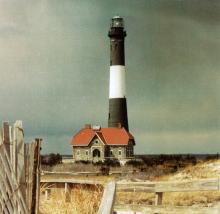
Fire Island is a unique barrier island with a varied ecosystem. The charms of the island are worth mentioning to set the stage for the story of the lighthouse. Lying off the southern coast of Long Island, Fire Island stretches 32 miles from Democrat Point at the west end to the Moriches Inlet on the east end. The Fire Island National Seashore manages the barrier beach plus a few small islands behind it and the boundary waters. This barrier island stands defiantly facing the Atlantic Ocean while protecting the waters of the Great South Bay, as well as the mainland of Long Island.
- Read more about Fire Island Lighthouse
- Log in to post comments
A Lighthouse for Race Rock

Thousands of years ago Long Island Sound was a large oval lake, carved out by the last Ice Age. At some point in time, the easternmost wall of this large lake eroded or otherwise collapsed, allowing the ocean to ebb and flow throughout the sound. The wall from Long Island to Connecticut, running northeast, consists of Plum, Little Gull and Fisher Islands as well as Valient Rock and Race Rock reefs. The remainder of this "wall" is below water, mostly 40 to 83 feet below low water.
- Read more about A Lighthouse for Race Rock
- Log in to post comments
Cold Spring Harbor Lighthouse 1890 - 1965: Only Yesterday

Congress was quick to respond to the 1874 petition for establishing a lighthouse at the entrance of Cold Spring Harbor but it would be another 15 years before construction began. The appropriation, which amounted to $20,000, called for erecting either range lights or a lighthouse. The Light House Service preferred range lights since, it was reasoned, the beacons would allow mariners to more easily avoid the shallows on the west side of the harbor's entrance.