
Gull Rock: A Little Lighthouse with a Big History (Part 1 & 2)
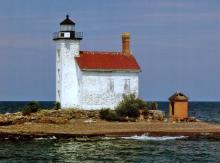
Gull Rock is a small island roughly the size of a football field consisting of conglomerate bedrock covered with a sprinkling of glacial till [the sediment deposited by a glacier]. The island sits in the open waters of Lake Superior and rises roughly 12 feet above the surface of the lake. As the name implies, Gull Rock is a well-established nesting area for gulls. Other than lichen and a few hardy crevice-borne bushes and plants, the rock is devoid of vegetation or even much topsoil.
Constructing Rock of Ages Lighthouse: Tinkham Tales
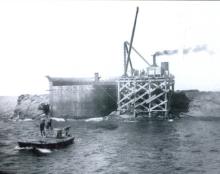
Over fifty years before the opening of the St. Lawrence Seaway (1959), I was building lighthouses and related engineering projects in some of the most isolated regions of the Great Lakes and along their connecting waterways.
Sand Island Light Station: Pages from the Past

Friday, April 20, 1900 - Keeper Emmanuel Luick and wife arrived at station with str. Hunter at 2 p.m. Found lots of ice to go through and the shore all blocked with heavy ice. Keeper found station o.k. and lit the light for the season. Wind - calm and clear very pleasant, at 7:00 p.m. Mr. Fred Hanson came after his mail.
- Read more about Sand Island Light Station: Pages from the Past
- Log in to post comments
Sand Island Light Station: Pages from the Past
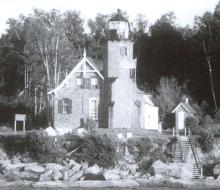
Great Lakes Light Stations were seasonal and operated from the time ice broke up enough yin the spring to allow ships to move until shipping ceased in the fall. A season could be as long as March to December or as short as mid-May to early November. Most of the Great Lakes light stations were small single or two family stations. However, the addition of a fog signal at a station would require more than two keepers. Because the stations were seasonal, Great Lakes Keepers were paid less than their counterparts on the coasts.
- Read more about Sand Island Light Station: Pages from the Past
- Log in to post comments
Sand Island Light Station: Pages from the Past

Over the next few issue Pages From the Past will feature excerpts from the journal of Ella Gertrude (Richardson) Luick, who married lighthouse keeper Emmanuel Luick in 1886 in Rhode Island. Prior to her marriage she was a correspondent for a newspaper, which may explain her chatty, illustrative entries. Emmanuel Luick was born in Ohio in 1866 to German immigrant parents. He entered the U. S. Lighthouse Service in 1889 as 2nd Assistant Keeper of the Outer Island Light Station, Lake Superion.
- Read more about Sand Island Light Station: Pages from the Past
- Log in to post comments
12 Children On A Rock In Lake Superior: Menagerie Island

We were sitting around on the grass-upholstered rocks of Menagerie Island, sailors from the lighthouse tender Marigold and I, talking of this and that, and watching the ship drifting about in Siskiwit Bay. The sailors were waiting for a bo'sun's chair so that a man could be lowered from the top of the automatic light to make certain repairs.
Raspberry Island Light Station: A Lighthouse Odyssey - Part 2
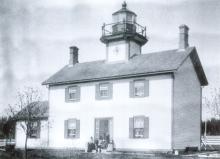
Many Lighthouse Service employees lacked the mechanical competency to operate the new fog signal machinery. The Naval Secretary wrote to the Eleventh District Inspector in December 1905, "The Board invites your attention to the fact that trouble is apt to come when steam or hot air fog-signal plants are put into old light-stations, as the keepers of such stations are likely to have little if any, knowledge of fog-signal machinery.
Raspberry Island Light Station: A Lighthouse Odyssey - Part 1
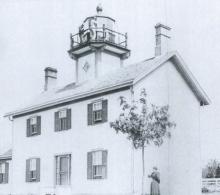
The year is 1863. Abraham Lincoln defeated Stephen Douglas and became the sixteenth President of the United States. The Civil War was raging. The Confederates were victorious over the Yankees at Chancellorsville. The tide turned later that year with two northtern victories at Gettysburg and Chattanooga. In the midst of this national crisis, the United States government constructed a lighthouse in Lake Superior, on Raspberry Island.
When Storms Lash Lighthouses (Apostle Islands)

Despite the lighthouses that mark them, treacherous rocks and reefs take their toll on ships that stray off the beaten path when gales whip Lake Superior to a frenzy. Men in these lonely lighthouses have thrilling stories to tell. Hans Christensen, head keeper on Devil's Island, stood by my side at the rail of the lighthouse tender Marigold. The tender was making its first trip of the season, distributing men and supplies to the most isolated posts on Lake Superior.
- Read more about When Storms Lash Lighthouses (Apostle Islands)
- Log in to post comments
Drama of the Lonely Men - Rock of Ages
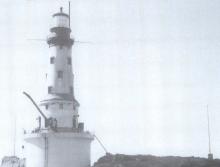
From the bow of the Marigold, John Soldenski silently watched his new home rise out of the lake as the lighthouse tender steadily forged through white-capped Lake Superior. At first he could see only the white shaft against the dark water. Gradually he could distinguish details of the circular tower, mounted on a great round base of concrete rising from the lake and surmounted by the housing of the great lens.
- Read more about Drama of the Lonely Men - Rock of Ages
- Log in to post comments