West Chop Lighthouse

The island of Martha's Vineyard lies six miles south of Cape Cod. It is basically triangular in shape and about 100 square miles in area. The island has three main towns: Edgartown, Oak Bluffs. and Vineyard Haven. Edgartown, now a wealthy resort town and tourist destination was, at one time, one of rhe primary whaling cities on the East Coast. Oak Bluffs (originally known as Cottage City) started out life as a summer Methodist Meeting campground, but it is now mainly a tourist destination.
- Read more about West Chop Lighthouse
- Log in to post comments
Scituate Lighthouse's First Keeper

The Massachusetts coast was a dark place two centuries ago. Boston Lighthouse had been lit for the first time in 1716, but it did not survive the American Revolution. The governing body that emerged from the war, that new nation formed on the strength of its belief in every man's right to life, liberty, and the pursuit of happiness, rebuilt it in 1783. Just before the war, a new light station at the end of Duxbury Beach, on a headland called the Gurnet (named for a fish known by the Pilgrims back home in England), was erected in 1768 to guard Plymouth Harbor to the south.
- Read more about Scituate Lighthouse's First Keeper
- Log in to post comments
Saving Straitsmouth Island Light Station

Since the U.S. Coast Guard left Straitsmouth Island Light Station in the 1930s, it has been owned by a number of private owners and by the 1960s had been totally abandoned. It has been on the doomsday list of endangered lighthouses since that time. A joint effort by the Thacher Island Association, the town of Rockport, and the Massachusetts Audubon Society has been established to save this historic and iconic lighthouse station first established in 1834.
- Read more about Saving Straitsmouth Island Light Station
- Log in to post comments
East Chop Lighthouse
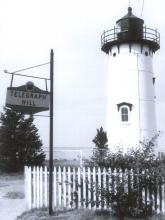
The north side of Martha's Vineyard Island is notched by a large V-shaped bay forming a harbor for the town of Vineyard Haven (originally called Homes Hole). The harbor is guarded on the east and west sides by capes known as East and West Chop. Since the beginning of our country, both chops have witnessed the passing of thousands of vessels. Until the construction of the Cape Cod Canal in the 1940s, the primary route of vessels transiting from Portland, Maine, in the north to New York and points south was past these two chops.
- Read more about East Chop Lighthouse
- Log in to post comments
Highland Lighthouse: First Lighthouse on Cape Cod

When Truro, the second most northerly town on Cape Cod, was first settled as Pamet 1646, it was part of the larger area then called Nauset. Pamet's name was changed to Truro (after a Cornish town it was said to resemble) when it was incorporated as a separate town in 1709. Truro developed a whaling fleet based at Pamet River Harbor, which comprised nine sloops by the early 1800s. In its early years, mariners knew Pamet as Dangerfield because of the frequent wrecks off its shores.
Cape Ann Light Station Thacher Island, Massachusetts: The Story of America's Last Operating Twin Lights

The Cape Ann Light Station on Thacher Island off the coast of Rockport, Massachusetts, is noted for some very significant firsts and lasts in the history of light stations in the U.S. It was the first lighthouse to mark a dangerous spot along the coast. The nine prior lighthouses simply marked harbor entrances. The original station was the 10th of the twelve stations built under British rule. The current towers are the last officially operating twin lights in the nation.
Obscure Cuttyhunk and its Light Station
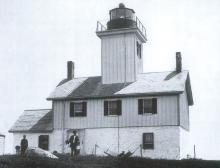
Eighteen years prior to the Pilgrims setting foot on Plymouth Rock, Englishman Bartholomew Gosnold discovered Cape Cod, Martha's Vineyard and the Elizabeth Islands. He set sail from Falmouth, England on March 26,1602 aboard the vessel Concord. His mission was to establish a colony at the northern end of Virginia, as the coast of North America was known in England. His small, 56-foot-long vessel carried 32 members of his party and it took seven weeks to make the crossing.
- Read more about Obscure Cuttyhunk and its Light Station
- Log in to post comments
The First Minots Ledge Lighthouse
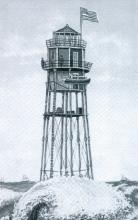
The demise of the first tower built to mark the hazardous Minots Ledge offCohasset, Massachusetts, is one of the most dramatic episodes in lighthouse history. Standing on a pile foundation, a relatively new construction technique at that time, the tower succumbed to a gale within 16 months of completion. Two assistant keepers perished. Although the event has been well documented in the past, primary source material recently uncovered by the author in the National Archives, expands and enriches our understanding of this tragic event.
- Read more about The First Minots Ledge Lighthouse
- Log in to post comments
Egg Rock, Massachusetts: Only Yesterday
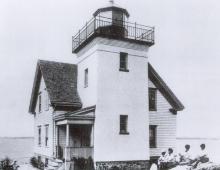
Located in Nahant Bay, of northern Boston Harbor, the Egg Rock Lighthouse became operational on Sept. 15, 1856. The structure consisted of a lantern on the keeper's dwelling. A fixed white light was produced by a 5th order Fresnel lens. The station was a single family station. In 1897 the structure was destroyed by fire. The replacement structure, constructed the following year, consisted of a 34-foot-high, brick tower attached to a white wooden dwelling. The new characteristic was a fixed red light. Egg Rock was automated in 1919 and the keeper removed.
- Read more about Egg Rock, Massachusetts: Only Yesterday
- Log in to post comments
The Lighthouses of Edgartown
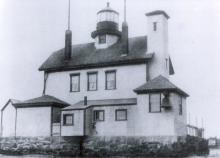
Records indicate that the people of Martha's Vineyard Island in Massachusetts were engaged in whaling as early as 1653, cutting up "drift whales." In the 19th century the Massachusetts towns of New Bedford, Nantucket and Edgartown were three of the busiest whaling ports in the state, if not the country. By 1775 the whaling vessels of Edgartown were realizing $150,000 a year from the industry. It was a dangerous industry.
- Read more about The Lighthouses of Edgartown
- Log in to post comments