
Heceta Head: A Light Station Odyssey
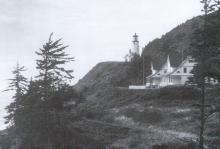
Heceta Head was named to commemorate one Don Bruno de Heceta, a Portuguese credited with exploring much of the Northwest Coast. Historians generally agree that Heceta, a captain sailing for the Royal Navy of Spain, left for his exploration of the Pacific Northwest coast on March 16, 1775. He launched his ship, Santiago, from San Blas, Mexico, carrying a year's provisions and 45 men; he was joined in the expedition by Juan Francisco de las Bodega Y Quadra, who sailed the Sanora.
- Read more about Heceta Head: A Light Station Odyssey
- Log in to post comments
Cape Henlopen: Only Yesterday
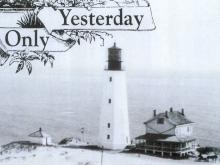
In 1788 Benjamin Franklin, President of the Supreme Executive Council of the Commonwealth of Pennsylvania, appointed a Committee of Wardens to investigate the condition of the Cape Henlopen light station, located in the State of Delaware. The tower was virtually built upon shifting sands and from its early days caused uneasiness as to its preservation.
- Read more about Cape Henlopen: Only Yesterday
- Log in to post comments
Letters of the Confederate States Lighthouse Bureau
Mobile - Oct. 2,1861
To: C.G. Menninger, Secretary of the Treasury
Sir,
I have the honor to enclose herewith the account of Mr. EA. Malone for his services as clerk to the Lighthouse Inspector for this District for the month of July last.
Point Reyes
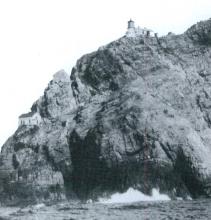
Point Reyes, historically named Punta de los Reyes, is an odd-shaped peninsula that protrudes into the Pacific Ocean about 35 miles northwest of San Francisco. The peninsula forms a triangle with Tomales Point on the north, Bolinas Point on the south, and the most prominent, Point Reyes, on the west. The peninsula is characterized by rolling hills covered by grass, brush or forest and surrounded by beaches.
- Read more about Point Reyes
- Log in to post comments
Split Rock
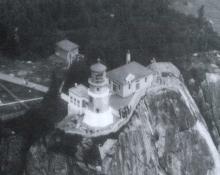
The date was November 10. The anniversary of the wreck of the Edmund Fitzgerald, the ill fated 729 foot ore carrier that had loaded at the docks in Superior, Wisconsin and headed downbound across the big lake past Split Rock Lighthouse to be swallowed up by Lake Superior during a massive storm on November 10, 1975 with the loss of all 29 hands. As historic site manager for the Minnesota Historical Society and resident keeper at Split Rock Lighthouse I have lit the beacon on the eve of November tenth for the last six years as a tribute to the ship and crew.
- Read more about Split Rock
- Log in to post comments
Northern Lights: Lighthouse Development in the Alaskan Territory
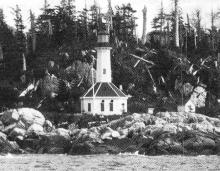
The first lighted aid to navigation in Alaska appears to have been established in 1805 by the Russians on a small island in Sitka Harbor (see Dee Longenbaugh's story in this issue). In later years (1830's) a light was placed in the cupola of their governor's mansion (Baranofs Castle) in Sitka. It was a crude optic consisting of four copper cans with solid wicks, fueled by whale or seal oil. The large reflector was placed behind the burning wicks.
Hillsboro Inlet Lighthouse: Pages from the Past

May 26, 1907 - I told the 1st assistant to sweep out the boat and he refused to, said I can report him and be damned.
May 30 -Took foreman to Deerfield, found out 1st Assistant has our launch right up to the bridge against my express order not to do so, and that was the reason the pump was out of order and the engine over heated. The water is too shallow and full of (sand) banks to go nearer than 3/4 mile of the bridge.
Point Arena: Lighthouse Memories

On July 1, 1937, we started north again, hiring a truck to take our furniture. Since the transfer was at Bill's request, we had to pay for transportation of our household effects. We went through several small towns before arriving at San Francisco, then we crossed the Golden Gate Bridge which had been completed the year before. The road was not too bad until we passed Jenner. In 1937, the Jenner Grade hardly seemed like a highway. It was fortunate we were driving during summer; in winter it was often closed because of slides.
- Read more about Point Arena: Lighthouse Memories
- Log in to post comments
Brant Point: America's Second Lighthouse
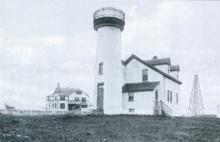
Brant Point Lighthouse, marking the entrance to the harbor of Nantucket, on the island of the same name, and the second oldest light station in the State of Massachusetts, as well as in the United States, is unique among United States lighthouses in several respects. It was the first and also among the very few lighthouses erected and maintained at the expense of a township. Probably no other light in this country has been shown from so many different structures, or has been moved about so much, for no less than seven successive lighthouses have been built on Brant Point.
- Read more about Brant Point: America's Second Lighthouse
- Log in to post comments
Kilauea Point: Landfall Beacon On the Orient Run
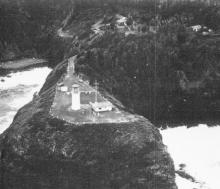
On a windswept point of land which stretches seaward from the rugged, verdant north shore of Kauai, Hawaii's westernmost inhabited island, there stands a stalwart member of the society of venerable lighthouses whose history is now characterized as near legendary in nature. This station, the Kilauea Point lighthouse, marked its 75th anniversary last May with a day long celebration honorng its former keepers who are still alive and commemorating the remarkable milestone in the life of Hawaii's "landfall light."