Tillamook Rock Lighthouse - Part 1 & 2
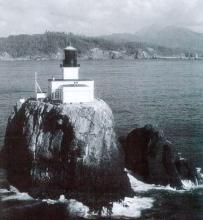
The Graveyard of the Pacific is a nickname given to the coastal region in the Pacific Northwest stretching from Tillamook Bay, on the Oregon Coast, northward to the tip of Vancouver Island, Canada. The prevailing northwest winds and south-streaming Japanese current tend to set vessels onto the lee shore. This coupled with the region's heavy seas; frequent and unpredictable weather; fog; and the rugged, rocky coast have caused the loss of numerous vessels and lives. More than 2,000 vessels and 700 lives have been lost near the Columbia River entrance alone.
- Read more about Tillamook Rock Lighthouse - Part 1 & 2
- Log in to post comments
Willamette River Light Station, Oregon: Only Yesterday
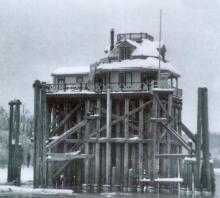
Since settlers began populating Washington Territory - the present states of Oregon and Washington - the mighty Columbia River has been a major water highway for the transportation of goods. Much of the river between its mouth and Portland, Oregon is wide and runs deep. But there are shallows and a few islands to restrict navigation. From the Lighthouse Service's earliest presence on the west coast, aids to navigation were provided on the Columbia River.
Cape Blanco

Cape Blanco was originally named by Spanish explorers in the 16th or early 17th century, although the origin is obscure. The cliff face is beige in color, but from a distance on sunny day appears white. Bird droppings and numerous fossil deposits contribute to the white color. In 1792 when Captain George Vancouver was exploring the west coast for England he named the headland Cape Orford in honor of his friend, George, the third Earl of Orford and son of Sir Robert Walpole. But a town near the cape founded in 1851 was named Port Orford and the cape continued to be called Cape Blanco.
- Read more about Cape Blanco
- Log in to post comments
1852: Dark Clouds Over The Pacific Coast Lighthouses - Part 1
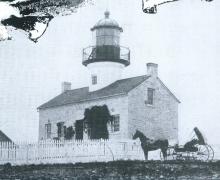
March 1, 1850 was a damp, cold day in the District of Columbia. The clouds were darker gray than usual and because the sun did not appear. This was the inauguration day of Millard Fillmore as the thirteenth President of the United States. At the Department of the Treasury the fires were banked in the fireplaces in the ornate offices, the window drapes were drawn, and the doors were locked.
Desdemona Sands: Only Yesterday

On January 1,1857 the bark Desdemona entered the Columbia River, Captain Francis Williams commanding, without a pilot, and promptly ran aground on a shoal off Astoria, OR. At the time the shoal was not named, but after Captain Williams' vessel became stranded and was eventually a total loss (including cargo) it was forever more called Desdemona Sands. Captain Williams complained, to avail, that a navigational buoy was off position and the cause of his stranding.
- Read more about Desdemona Sands: Only Yesterday
- Log in to post comments
Yaquina Head Lighthouse

"Moderate to fresh breezes S. To S.E. these 24 hours last 12 hours some damp fog sea moderately smooth Keeper Capt. S. L. Wass died at 2 P.M."
-February 9, 1886, keeper's log, Yaquina Head Lighthouse.
- Read more about Yaquina Head Lighthouse
- Log in to post comments
Point Adams: Only Yesterday
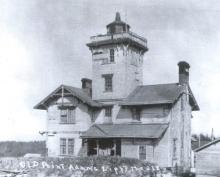
Point Adams Light Station was constructed in 1875 on the south side of the Columbia River to assist vessels entering that waterway. It was the most northerly light station on the Oregon coast and of a design similar to Point Hueneme and Point Fermin in southern California. The main building consisted of a two-story redwood Victorian with a four-story tower attached. The lens was a 4th order and originally displayed an alternating red and white flashing light, visible for 11 miles. The station included a fog signal building and the usual outbuildings.
- Read more about Point Adams: Only Yesterday
- Log in to post comments
Heceta Head: A Light Station Odyssey
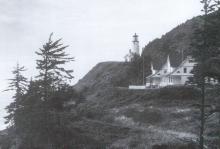
Heceta Head was named to commemorate one Don Bruno de Heceta, a Portuguese credited with exploring much of the Northwest Coast. Historians generally agree that Heceta, a captain sailing for the Royal Navy of Spain, left for his exploration of the Pacific Northwest coast on March 16, 1775. He launched his ship, Santiago, from San Blas, Mexico, carrying a year's provisions and 45 men; he was joined in the expedition by Juan Francisco de las Bodega Y Quadra, who sailed the Sanora.
- Read more about Heceta Head: A Light Station Odyssey
- Log in to post comments
Terrible Tilly Revisited

The lighthouse keeper has gone the way of the iceman and the blacksmith, but his story remains. Here are the unique adventures I experienced as a lighthouse keeper on a seagirt piece of real estate off Oregon's timeless shores. Since that adventure at Tillamook Rock lighthouse, more than a couple of decades have passed, during which automation, computerization and many other remarkable innovations, such as television, have become an accepted way of life.
- Read more about Terrible Tilly Revisited
- Log in to post comments