The Saga of Abbie Burgess Grant

In the spring of 1853, Samuel Burgess was appointed keeper of Matinicus Rock Light Station. His family included an invalid wife, a son and four daughters. Within a few years the son left to become a fisherman and, in fact, Samuel also spent a great deal of time away from the light station fishing in Bay Chaleur. His only assistant was the eldest daughter, Abbie. She became quite proficient in the duties of lighthouse keeper. On January 19, 1856, when she was 17 years old and while her father was off the island, a winter gale lashed the islet.
- Read more about The Saga of Abbie Burgess Grant
- Log in to post comments
Humboldt Harbor Lighthouse: Only Yesterday
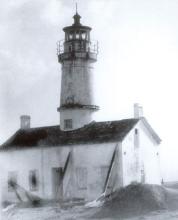
The population explosion of San Francisco and central California due to the Gold Rush created a tremendous demand for lumber to construct new houses and commercial buildings. Although there were lumber trees in the Bay Area and up in the Sierras, the tall redwood and Douglas fir trees in the Humboldt Bay area provided the most abundant and economical supply. The Bar Channel into Humboldt Bay is as dangerous as any on the west coast, but the Bay is broad and fairly sheltered.
- Read more about Humboldt Harbor Lighthouse: Only Yesterday
- Log in to post comments
The Depot

Since the establishment of the first lighthouse at Boston Harbor's Little Brewster Island in 1716, lighthouses have needed supplies. Our first lighthouse keeper, George Worthylake, ferried his supplies to Boston Lighthouse via rowboat. But as the service grew and the number of light stations increased, more than rowboats were needed. The materials the government furnished light stations and the means of furnishing them varied over the years. Until 1852, lighthouses were a collateral duty of the local Collector of Customs.
- Read more about The Depot
- Log in to post comments
Mare Island Light Station: Only Yesterday
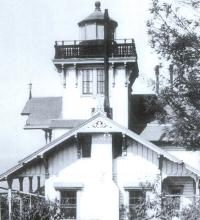
By the 1870's San Francisco Bay was teeming with ship traffic. Vessels arriving from other states and foreign lands called at the Port of San Francisco and the inland ports of Sacramento, Stockton and other inland cities. The increase in vessel traffic necessitated more aids to navigation along the waterways. One site was at the confluence of San Pablo Bay and Mare Island Strait.
- Read more about Mare Island Light Station: Only Yesterday
- Log in to post comments
Ballast Point: Only Yesterday
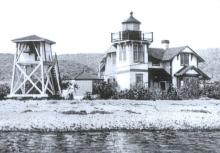
In 1855 the Lighthouse Service constructed the first Point Loma Light Station high on a bluff to mark the entrance to San Diego Harbor. The location was thought to serve two purposes: 1) show the entrance to San Diego Harbor, and 2) act as a seacoast light to help vessels fix their position. In actuality, it served neither. It was too far from the channel into San Diego Harbor to help vessels navigate the narrow channel and it was too high to be of use to vessels sailing offshore as layers of low coastal fog obscured the light.
- Read more about Ballast Point: Only Yesterday
- Log in to post comments
Old Point Loma
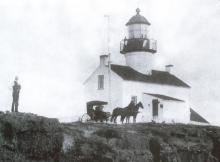
The 1850s were a period of flux for the nation's aid to navigation systems. During the 1850s, the Lighthouse Board replaced the inept 5th Auditor of the Treasury and brought about a change of rules and regulations. Keepers of light stations now had to be able to read and write, something which wasn't required under the old regime. The new board also modernized the system of aids to navigation in this country. One of the most important changes was the introduction of the Fresnel lens which had been invented in 1822 and installed in most maritime country's light stations.
- Read more about Old Point Loma
- Log in to post comments
Point Knox (Angel Island): Only Yesterday

The 1885 report of the Lighthouse Board reported, "By the Act of March 3, 1885 an appropriation of $4,500 was made for the establishment of a fog bell here [Ed. at Point Knox on Angel Island in San Francisco Bay]. A site on the western side was selected, plans and estimates made, and the work has been commenced. The bell and machinery are in readiness in San Francisco, but it was found necessary to change the plans in certain respects, thereby involving further expense.
- Read more about Point Knox (Angel Island): Only Yesterday
- Log in to post comments
Horn Island: Only Yesterday
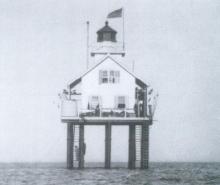
A series of low off-shore islands off the Mississippi Coast form Mississippi Sound, a fairly well protected waterway. This sound experienced a large increase in coastal trading after the Civil War. In addition to a rapid growth of waterborne commerce, the area became increasingly popular with the fishing fleet. The increase in vessel traffic by the 1870s triggered the Lighthouse Service to establish more aids to navigation. In 1872 the Service successfully petitioned Congress for $22,000 to construct a lighthouse on Horn Island.
- Read more about Horn Island: Only Yesterday
- Log in to post comments
Willapa Bay: Only Yesterday

John Meares was an independent British fur trader commanding the East India Company ship Felice Adevturer. While exploring the Washington coast in 1788, he attempted to enter a bay sheltered by a cape. He wrote in his log, "We shoaled our water gradually to six fathoms. We immediately hauled off the shore until we deepened our water to sixteen fathoms" [Ed. a fathom is six feet]. With this attempt, he named both the cape and the bay 'Shoalwater.'
- Read more about Willapa Bay: Only Yesterday
- Log in to post comments
Desdemona Sands: Only Yesterday

On January 1,1857 the bark Desdemona entered the Columbia River, Captain Francis Williams commanding, without a pilot, and promptly ran aground on a shoal off Astoria, OR. At the time the shoal was not named, but after Captain Williams' vessel became stranded and was eventually a total loss (including cargo) it was forever more called Desdemona Sands. Captain Williams complained, to avail, that a navigational buoy was off position and the cause of his stranding.
- Read more about Desdemona Sands: Only Yesterday
- Log in to post comments