Point Robinson Light Station: "The Fog Net"
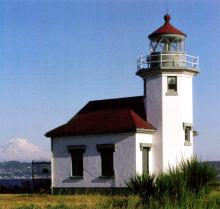
Puget Sound's East Passage, connecting the large port cities of Seattle and Tacoma, is today one of the nation's busiest waterways. Numerous minor lights and three important lighthouses-Alki Point, Point Robinson, and Browns Point-mark this murky portal. The Coast Guard monitors as many as 15,000 vessel movements in the East Passage every month, many of them container ships and barges. Prior to the 1870s, however, there was little more than the occasional schooner, sloop, or lighter traveling the East Passage and southern Puget Sound was sparsely populated by mostly farmers and fishermen.
- Read more about Point Robinson Light Station: "The Fog Net"
- Log in to post comments
Victor Smith's Lighthouse Legacy
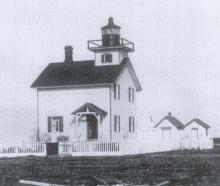
In July 1861, Victor Smith arrived in Port Townsend, Washington Territory, the Port Entry for the Puget Sound Customs District. He came as the district's new collector of customs, appointed by President Abraham Lincoln on the advice of Secretary of Treasury Salmon P. Chase. As collector of customs, Smith's principle duties would be documenting vessels entering the port and collecting duties on behalf of the United States.
- Read more about Victor Smith's Lighthouse Legacy
- Log in to post comments
Ediz Hook, WA: Only Yesterday
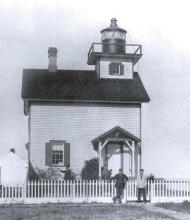
In 1863 President Abraham Lincoln authorized the establishment of a new lighthouse for the west coast on the Straits of Juan de Fuca in Washington. Ten acres were reserved at the end of a peninsula known as Ediz Hook. The following year Congress appropriated $5,000 to construct the station. Today's value would be over $100,000, which was a lot of money to spend during a costly war.
- Read more about Ediz Hook, WA: Only Yesterday
- Log in to post comments
Cape Flattery Light Station

Cape Flattery is the most northwest point of the continental United States. It's a desolate and rigorous location and guards the southern entrance to the Strait of Juan de Fuca. Swirling, strong currents live here. The lofty mountains of Washington's Olympic Peninsula block storm clouds arriving from the northwest, causing the area to experience the heaviest rainfall in the country: 100 inches a year. The warm Japanese Current sweeps by Cape Flattery and the on-shore breezes create heavy walls of fog during much of the year.
- Read more about Cape Flattery Light Station
- Log in to post comments
The Lone Tree Light
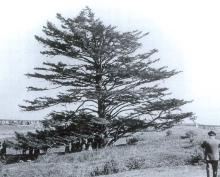
It was 1888, when as a youth, I hewed out a cedar canoe on Black Lake, near Olympia, Washington, and shoved thru the brush down the Black and Chehalis Rivers. This canoe went over the ancient voyagers route to a new beginning in the remote area known as Grays Harbor. The saw mills and logging were new then and jobs were hard to find. I picked up a notice at the Hoquiam Post Office stating a channel lamp keeper was needed paying $12 per month. I found the proper authority, met the qualifications, and was hired at once.
- Read more about The Lone Tree Light
- Log in to post comments
Smith Island: Only Yesterday
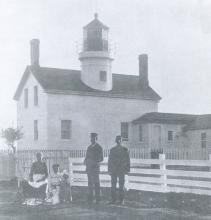
Viewed as a small spot across the Strait of Juan de Fuca from Port Townsend, Washington, Smith Island is approximately fifteen acres in area, a half mile in length and from a height of 55 feet at the west end drops to nearly sea level on the east end. At low tide it is connected to an islet known as Minor Island. Smith Island was the site of one of the original 16 light stations constructed on the west coast in the 1850's and the site of the last Indian uprising in the area. For many years it was dependent on the town of Port Townsend for supplies.
- Read more about Smith Island: Only Yesterday
- Log in to post comments
Willapa Bay: Only Yesterday

John Meares was an independent British fur trader commanding the East India Company ship Felice Adevturer. While exploring the Washington coast in 1788, he attempted to enter a bay sheltered by a cape. He wrote in his log, "We shoaled our water gradually to six fathoms. We immediately hauled off the shore until we deepened our water to sixteen fathoms" [Ed. a fathom is six feet]. With this attempt, he named both the cape and the bay 'Shoalwater.'
- Read more about Willapa Bay: Only Yesterday
- Log in to post comments
Admiralty Head Lighthouse
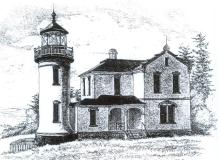
The Admiralty Head Lighthouse was lit in 1861 to guide sailing ships through Washington's Admiralty Inlet. It stood on a bluff on Whidbey Island at the eastern end of the Strait of Juan de Fuca. When the sailing ship era came to a close, the light, then shining from the second Admiralty Head Lighthouse, was extinguished in 1922.
- Read more about Admiralty Head Lighthouse
- Log in to post comments