Willamette River Light Station, Oregon: Only Yesterday
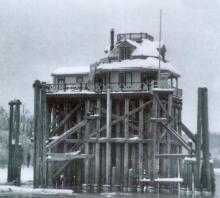
Since settlers began populating Washington Territory - the present states of Oregon and Washington - the mighty Columbia River has been a major water highway for the transportation of goods. Much of the river between its mouth and Portland, Oregon is wide and runs deep. But there are shallows and a few islands to restrict navigation. From the Lighthouse Service's earliest presence on the west coast, aids to navigation were provided on the Columbia River.
Obscure Cuttyhunk and its Light Station
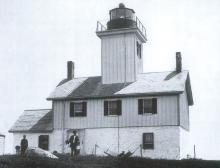
Eighteen years prior to the Pilgrims setting foot on Plymouth Rock, Englishman Bartholomew Gosnold discovered Cape Cod, Martha's Vineyard and the Elizabeth Islands. He set sail from Falmouth, England on March 26,1602 aboard the vessel Concord. His mission was to establish a colony at the northern end of Virginia, as the coast of North America was known in England. His small, 56-foot-long vessel carried 32 members of his party and it took seven weeks to make the crossing.
- Read more about Obscure Cuttyhunk and its Light Station
- Log in to post comments
The Little Known Lighthouse of New Buffalo, Michigan: Only Yesterday

The opening of the Erie Canal in 1822 brought the outside world to the Great Lakes. The huge increase in vessel traffic dictated the establishment of lighthouses and other aids to navigation. But in that era, with Stephen Pleasonton in charge of our aids to navigation system, the placement of aids was not always done in a logical manner. Some were established for political reasons, others in response to a "squeaky wheel."
Mahon River Light Station: Only Yesterday
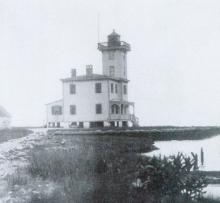
The Delaware Bay and River were very busy waterways in the early 19th century. Numerous lighthouses and other aids to navigation were constructed to guide the mariner up the shoal-laced bay and twisting river. Many of the lighthouses also served to mark harbor or inlet entrances. One of those dual-purpose lighthouses was located at the entrance to Delaware's Mahon River.
- Read more about Mahon River Light Station: Only Yesterday
- Log in to post comments
Chairman of the Board Radm William Shubrick
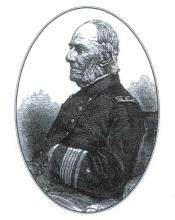
William Branford Shubrick was born in 1790 on the Belvedere plantation on Bull Island, SC. He was the ninth child of a family of sixteen. The island derived its name from Governor Bull. At the time of Shubrick's birth, the island was owned by his father, Colonel Thomas Shubrick, who had distinguished himself during the Revolutionary War. Belvedere plantation grew the prized "sea island" cotton of South Carolina. In 1852, as the first Chairman of the Lighthouse Board, William Shubrick authorized the construction of a lighthouse on Bull Island known as the Bull's Bay Light Station.
- Read more about Chairman of the Board Radm William Shubrick
- Log in to post comments
Greenbury Point and Shoal Lighthouses: Only Yesterday
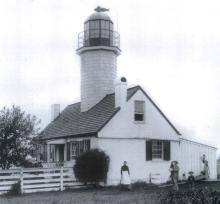
Due to a heavy increase in commerce into Annapolis Harbor and the Severn River, the Maryland House of Delegates passed a resolution to petition the Lighthouse Service to construct a lighthouse on Greenbury Point, on the north side of the entrance into Annapolis Harbor. A year later Congress appropriated $3,500 on March 3, 1847. Fifth Auditor Pleasonton instructed the Collector of Customs in Annapolis to select a site for the new station and purchase the necessary acreage.
Egg Rock, Massachusetts: Only Yesterday
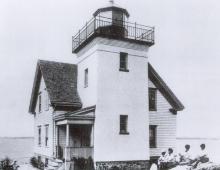
Located in Nahant Bay, of northern Boston Harbor, the Egg Rock Lighthouse became operational on Sept. 15, 1856. The structure consisted of a lantern on the keeper's dwelling. A fixed white light was produced by a 5th order Fresnel lens. The station was a single family station. In 1897 the structure was destroyed by fire. The replacement structure, constructed the following year, consisted of a 34-foot-high, brick tower attached to a white wooden dwelling. The new characteristic was a fixed red light. Egg Rock was automated in 1919 and the keeper removed.
- Read more about Egg Rock, Massachusetts: Only Yesterday
- Log in to post comments
Ludlam Beach, NJ Lighthouse: Only Yesterday

In the early 1880's the Lighthouse Service realized a need for a lighthouse between the Absecon station at Atlantic City, New Jersey and the Hereford Inlet Lighthouse at North Wildwood. The site selected was at Sea Isle City, 17 miles south of Atlantic City and 11 miles north of Hereford Inlet. This site would provide a navigational aid between the two lighthouses and assist mariners to steer clear of a shoal off nearby Townsend Inlet.
- Read more about Ludlam Beach, NJ Lighthouse: Only Yesterday
- Log in to post comments
The Lighthouses of Edgartown
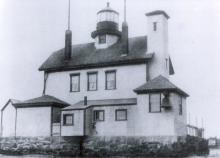
Records indicate that the people of Martha's Vineyard Island in Massachusetts were engaged in whaling as early as 1653, cutting up "drift whales." In the 19th century the Massachusetts towns of New Bedford, Nantucket and Edgartown were three of the busiest whaling ports in the state, if not the country. By 1775 the whaling vessels of Edgartown were realizing $150,000 a year from the industry. It was a dangerous industry.
- Read more about The Lighthouses of Edgartown
- Log in to post comments
Bridgeport, Connecticut Lighthouse: Only Yesterday
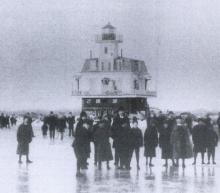
Bridgeport's first aid to navigation was established in 1806, when Congress appropriated $1,000 to construct an unlighted beacon at the entrance to the harbor. It was an iron spindle surmounted with a cage and often had to be replaced after being destroyed by storms or ice floes. In the 1820s, steamboat service was established between Bridgeport, CT and other ports along Long Island Sound. In those early years, cargo consisted primarily of passengers and oysters harvested from the harbor.