Mayo Beach: Only Yesterday
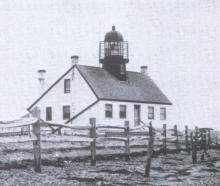
On November 1, 1838, Lt. Edward W. Carpender, USN, submitted a report to Secretary of the Treasury Levi Woodbury on his findings of the condition of several American light stations. The year before, due to a Congressional mandate, he was directed to conduct a survey of the condition of our clighthouses. He spent a considerable amount of time during 1838 traveling the East Coast. In his report he noted, " . . .I was surprised to find a light-house building on Mayo's Beach, at the head of this harbor [Wellfieet], and wrote to you in hopes of arresting the work."
- Read more about Mayo Beach: Only Yesterday
- Log in to post comments
Point Adams: Only Yesterday
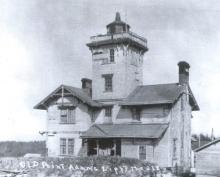
Point Adams Light Station was constructed in 1875 on the south side of the Columbia River to assist vessels entering that waterway. It was the most northerly light station on the Oregon coast and of a design similar to Point Hueneme and Point Fermin in southern California. The main building consisted of a two-story redwood Victorian with a four-story tower attached. The lens was a 4th order and originally displayed an alternating red and white flashing light, visible for 11 miles. The station included a fog signal building and the usual outbuildings.
- Read more about Point Adams: Only Yesterday
- Log in to post comments
Billingsgate Lighthouse
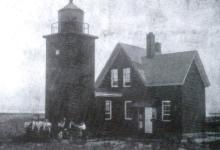
In 1620 the Mayflower found an island of some 60 acres on the north side of Cape Cod. It is said the plentiful bounty of fish in the area caused it to be named Billingsgate after a large fish market in London. At one time the island supported a small community, that included a trying works and the lighthouse, but it's all gone, now that the island has disappeared.
- Read more about Billingsgate Lighthouse
- Log in to post comments
Santa Barbara: Only Yesterday
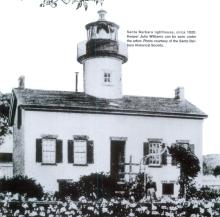
Shortly after gold was discovered in California, the federal government was pressed to construct suitable aids to navigation along the west coast to safeguard maritime commerce. The initial appropriation for west coast lighthouses was passed in the fall of 1850. It authorized the construction of six stations in California and one in the Washington Territory. The next year Humboldt Bay, CA, was added to the initial list. The contract for the construction of those stations was awarded to the firm of Gibbons and Kelly of Baltimore, MD which built them between 1854 and 1856.
- Read more about Santa Barbara: Only Yesterday
- Log in to post comments
Punta Gorda Light Station: Only Yesterday
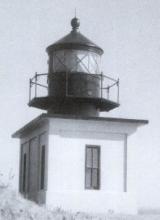
The California coast north of Point Arena indents to the east in a long sweeping arc for some 75 miles before emerging at a bump known as Punta Gorda. Some ten miles north of this protrusion is Cape Mendocino, one of the most westerly points on the west coast and a major turning point for vessels that engaged in the coastal trade in the 19th and early 20th centuries. The most obvious place for a light station was Cape Mendocino and a lighthouse was constructed there in 1870.
- Read more about Punta Gorda Light Station: Only Yesterday
- Log in to post comments
Roe Island Light Station Suisun Bay, CA
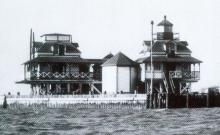
It wasn't much of an island and it was a rather unusal site for a lighthouse, still it served mariners heading up and down river for 54 years. Roe Island, a low marshy tract often inundated, is situated in the southern center area of Suisun Bay, California. The island abuts the northern edge of the shipping channel linking San Francisco Bay with ports of the Sacramento Delta. Being some 33 miles inland the island would, at first blush, seem an unlikely place for a lighthouse.
- Read more about Roe Island Light Station Suisun Bay, CA
- Log in to post comments
Shinnecock: Only Yesterday
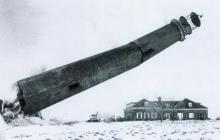
Montauk Point at the tip of Long Island, NY, was the first land sighted by vessels sailing to New York City from Europe, and an important turning point for vessels bound from New England to New York. Recognizing this the federal government constructed a lighthouse at Montauk Point in 1797. To further assist vessels navigate the length of Long Island, another lighthouse was constructed 75 miles west on Fire Island in 1826.
- Read more about Shinnecock: Only Yesterday
- Log in to post comments
Cape Henlopen: Only Yesterday
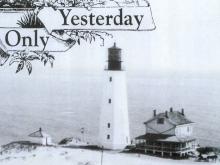
In 1788 Benjamin Franklin, President of the Supreme Executive Council of the Commonwealth of Pennsylvania, appointed a Committee of Wardens to investigate the condition of the Cape Henlopen light station, located in the State of Delaware. The tower was virtually built upon shifting sands and from its early days caused uneasiness as to its preservation.
- Read more about Cape Henlopen: Only Yesterday
- Log in to post comments
LV-50–Columbia
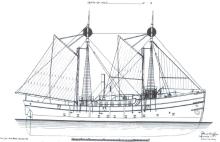
A Congressional Act of 1889 provided $50,000 to construct lightship LV 50, a composite vessel, to be moored at the mouth of the treacherous Columbia River Bar. Composite vessels were steel framed and wood planked. The frames, floors, keelsons, stringers, beams, sheer and bilge strakes, keel plate, etc., were steel. The planking and other wood sections were made of Georgia and Florida pine, the sheathing of white oak.
- Read more about LV-50–Columbia
- Log in to post comments
Lighting Vessels at Night
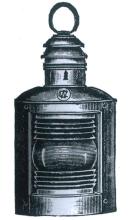
Recently, while doing some research in our Society's library, I came across a report of the treasury dated December 15, 1846, titled, The expediency of requiring vessels navigating along the coasts to carry lights. I was amazed to learn that there was time as recent as the 19th century when vessels navigating at night were not required to display navigation lights.
- Read more about Lighting Vessels at Night
- Log in to post comments