
From its beginning, in 1789, until 1852, the U.S. Lighthouse Service sputtered along, supplies suffering from growing pains and mismanagement. In 1789 there were 12 lighthouses and a smattering of minor aids to navigation. By 1800 some 26 stations existed. After that time, aids to support the 'needs of commerce' increased dramatically as politicians added lighthouse construction to their 'pork barrel.' We were an emerging mercantile nation, growing by leaps and bounds. As commerce increased and ports developed, there was a need to expand the aids to navigation system.

When scientific technology and the necessity for economic savings are melded, the results are often fascinatingly ingenious. Invariably though, one aspect that is lost in such advancing change is the element of nostalgia, which is ushered out of relevance in favor of technology's irresistible lure and promise of a more efficient tomorrow.

In July 1861, Victor Smith arrived in Port Townsend, Washington Territory, the Port Entry for the Puget Sound Customs District. He came as the district's new collector of customs, appointed by President Abraham Lincoln on the advice of Secretary of Treasury Salmon P. Chase. As collector of customs, Smith's principle duties would be documenting vessels entering the port and collecting duties on behalf of the United States.

There are many conflicting stories of how the Vineyard lightship sank during the hurricane of that September 14/15, 1944; perhaps with this article some of the misinformation can be corrected. Using some known and available facts, along with a little background history, the Vineyard Lightship tragedy may be better understood.

In the days before electricity and electric motors came to the shores, it was a weight-driven gearbox that provided the motive power to turn even immensely heavy Fresnel lenses to produce those flashes of light.

The island of Martha's Vineyard lies six miles south of Cape Cod. It is basically triangular in shape and about 100 square miles in area. The island has three main towns: Edgartown, Oak Bluffs. and Vineyard Haven. Edgartown, now a wealthy resort town and tourist destination was, at one time, one of rhe primary whaling cities on the East Coast. Oak Bluffs (originally known as Cottage City) started out life as a summer Methodist Meeting campground, but it is now mainly a tourist destination.

Each morning at 0300 hours, every day of the year, another workday begins for the keepers of British Columbia's 35 staffed lightstations. From the tide-ripped waters of the Strait of Juan de Fuca north to the wind battered Alaska Panhandle, and along 500 miles of tortuous coast in between, 70 keepers and their families continue a tradition of lifesaving, weather reporting and environmental monitoring that began almost a century and a half ago.
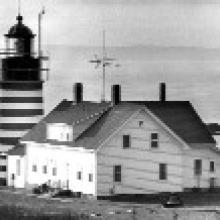
Established in 1808, the West Quoddy Light Station was the first and only station in the nation’s Light List (LL No. 1) until the St. Croix River station was completed in 1858. It is the easternmost light station in the country, one of only two red and white banded US towers, and among the first to be equipped with a bell fog signal and, later, a steam whistle.

The March 2, 1827 appropriation of $1,500 was woefully inadequate. How could a lighthouse be constructed on Whale's Back Ledge, Portsmouth, NH, asked Fifth Auditor and Superintendent of Lighthouses Stephen Pleasonton, when others in the area of "the lowest grade," had cost no less than $5,000? Further he noted, "to the southward of New Jersey, from five to eight thousand may be estimated as the cost."

Despite the lighthouses that mark them, treacherous rocks and reefs take their toll on ships that stray off the beaten path when gales whip Lake Superior to a frenzy. Men in these lonely lighthouses have thrilling stories to tell. Hans Christensen, head keeper on Devil's Island, stood by my side at the rail of the lighthouse tender Marigold. The tender was making its first trip of the season, distributing men and supplies to the most isolated posts on Lake Superior.