

Great complaint is made about the keeper of the light at this place. He is a habitual drunkard, frequently thrashes his wife and throws her out of doors. He has several times failed to light up till near morning - last night he did not light up until after midnight - it was a dark stormy night - three sail vessels and one steamer came in during the night.
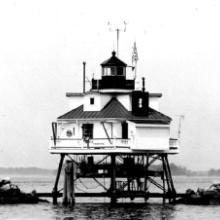
The Chesapeake Bay, at 180 miles in length, is one of the great protected waterways of the country. Because of its natural configuration it became the home of many of our earliest ports of call: Norfolk, Portsmouth, Annapolis, Baltimore and, farther up the Potomac, Alexandria and Washington. These were all bustling seaports early in the beginning of our nation. But for all its size, Chesapeake Bay is shallow in many areas, with limited deep water channels. The need for aids to navigation was evident early on.

When most people think of the rescues of the old U.S. Life-Saving Service they mentally picture the pounding surf along the beaches of Cape Hatteras, or other eastern seaboard locales. Yet, the service conducted some extraordinary rescues on the "inland seas" of the Great Lakes. Beginning on October 31, 1883, a series of events took place at Cleveland, Ohio, to prove this statement. On October 31, the three-masted schooner Sophia Minch attempted to enter Cleveland harbor in a stiff northwesterly gale. As fate would have it, the ships rudder was disabled by the rough seas.

The Graveyard of the Pacific is a nickname given to the coastal region in the Pacific Northwest stretching from Tillamook Bay, on the Oregon Coast, northward to the tip of Vancouver Island, Canada. The prevailing northwest winds and south-streaming Japanese current tend to set vessels onto the lee shore. This coupled with the region's heavy seas; frequent and unpredictable weather; fog; and the rugged, rocky coast have caused the loss of numerous vessels and lives. More than 2,000 vessels and 700 lives have been lost near the Columbia River entrance alone.

There is a tiny island, Flatholmen, which lies about a mile off the coast of Jaeren, in Southwest Norway. The nearest harbor is Tananger, and across a peninsula, in the more sheltered water of the fjords, lies the great port of Stavanger. One of many lighthouse islands, Flatholmen shows the safe channel between the mainland and the reefs which lie further west, around the larger island of Rott, bird sanctuary. A lighthouse was first built on Flatholmen in 1862; a boathouse added in 1863, an outbuilding, including a laundry, in 1894.

In the mid-winter of 1954 I flew from Detroit to Seattle and then on to Sitka Island, Alaska. From there, I was taken in a two-engine amphibian to Ketchikan where the coastal mountains allowed only a narrow ledge for the town and no place for an airport. Water planes had always been my favorites: flying boats, seaplanes, amphibians, and float planes. It was a short flight and the splashy landing took me by surprise.

The Tucker Beach light station of New Jersey not only disappeared but the entire island on which it stood - along with several cottages, a Coast Guard station, a school, two hotels, a boarding house and other buildings - also vanished under the Atlantic. At one time Tucker Island (also called Sea Haven, Short Beach and Tucker's Beach at different times) was part of the mainland attached to the south end of Long Beach Island. Eventually the sea encroached on the north causing an island sorne 8 miles long. By 1877 Tucker Island was reduced to a mile in length.
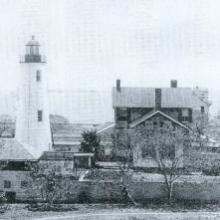
The Old Point Comfort Light Station is an anomaly. One usually imagines the life of a keeper to be characterized by hardship and isolation. The history of the quaint station at Old Point Comfort on the end of the Virginia Peninsula, however, has long been the opposite of this scenario. In 1775, state officials paid £20 a year to maintain a beacon at the Point. With the flow of merchant vessels through the Virginia Capes, navigators suggested the need for a permanent structure.

On November 11, 1792, the following signed statement was made by the keeper of the Tybee Island Lighthouse concerning a fire that nearly destroyed the tower. It is written in his own word and with his own spelling: On the 7th of November 1792 I was on Tibe [Tybee] and that day their came a number of gentlemen their, a part of which went up into the litehouse top and i went their myself i saw nothing that i conceived to be dangerous. The gentlemen all went away that day.

Lighthouses and buoys have been essential aids to navigation in the United States since colonial times. Originally the government contracted private vessels to service the country's aids to navigation or relied on cutters of the U.S. Revenue Cutter Service. As the nation grew, so did its system of aids to navigation, and in the 185Os, the U.S. Light-House Board designed a vessel specifically for tending aids to navigation. Gradually, most lighthouse districts came to own at least one tender, some powered by sail, others by steam.