
Absecum, New Jersey: Pages from the Past
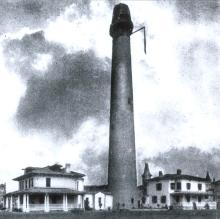
In conformity with the Notice to Mariners of 10th November last, notice is hereby given that the Tower and keeper's dwelling at Absecum, N.J., are now completed, and a light will be exhibited therefrom, for the first time, at sunset on the 15th of January, 1857, and every night thereafter from sunset to sunrise. The tower is of brick, unpainted, and is surmounted by an iron lantern painted black. The illuminating apparatus is catadioptric of the first order of Fresnel, showing a fixed white light.
- Read more about Absecum, New Jersey: Pages from the Past
- Log in to post comments
Ludlam Beach, NJ Lighthouse: Only Yesterday

In the early 1880's the Lighthouse Service realized a need for a lighthouse between the Absecon station at Atlantic City, New Jersey and the Hereford Inlet Lighthouse at North Wildwood. The site selected was at Sea Isle City, 17 miles south of Atlantic City and 11 miles north of Hereford Inlet. This site would provide a navigational aid between the two lighthouses and assist mariners to steer clear of a shoal off nearby Townsend Inlet.
- Read more about Ludlam Beach, NJ Lighthouse: Only Yesterday
- Log in to post comments
A Lighthouse for Brandywine Shoal: America's First Screw-pile

Since the Colonial period, one of the major waterways on the eastern seaboard has been the Delaware Bay and River. The Bay and River, separating New Jersey from Pennsylvania and Delaware, stretches from the mouth all the way to Philadelphia, Camden and Trenton. Prior to the completion of the Ene Canal in 1825, which elevated New York City to a major port, Philadelphia and Boston were the primary seaports of the colonies and our new nation. One of the twelve colonial lighthouses was situated at Cape Henlopen, on the south side of the entrance to the Bay.
The Saga of the Barnegat Lighthouse

Maintaining shore lights locations at strategic locations along the coastlines of the middle-Atlantic states has always been difficult. The Atlantic coast is in a constant state of flux. Inlets to protected interior waters possess a natural tendency to work south. Therefore the frequently perilous state of "Old Barney," as the Barnegat Lighthouse on Long Beach Island in New Jersey was nicknamed at some point in the dim past, cannot be separated from the natural antics of Bamegat Inlet. They may be compared to an incompatible married couple.
- Read more about The Saga of the Barnegat Lighthouse
- Log in to post comments
Cape May Lighthouse
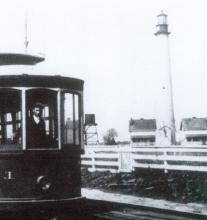
Clould Cape May really have been dark until 1823? Recorded history tells us that it was. However, scattered clues point to an earlier light on this historically busy Cape: Cape May at the southernmost tip of New Jersey, marks the northeast side of the entrance to Delaware Bay. The Cape's earliest settlers were bay pilots, ship builders, and whalers. Cape May's whaling industry in the 1680's rivaled that of Cape Cod's. And Delaware Bay has been one of the nation's busiest waterways since Colonial times.
- Read more about Cape May Lighthouse
- Log in to post comments
Absecon Lighthouse

Dr. Jonathan Pitney, who would one day be called the Father of Atlantic City, was acutely aware of the danger to mariners which existed along the beaches he regarded as otherwise beneficent. In 1820 this former scountry physician arrived in the Absecon area. He encouraged his patients and friends to take vacations in the area. By 1830 he had witnessed enough ship wrecks to realize a lighthouse was needed to assist the mariner. He began to petition for the beacon, and for the next 20 years his letters to the government fell on deaf ears.
- Read more about Absecon Lighthouse
- Log in to post comments
Tucker Beach Lighthouse
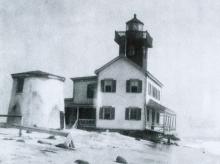
The Tucker Beach light station of New Jersey not only disappeared but the entire island on which it stood - along with several cottages, a Coast Guard station, a school, two hotels, a boarding house and other buildings - also vanished under the Atlantic. At one time Tucker Island (also called Sea Haven, Short Beach and Tucker's Beach at different times) was part of the mainland attached to the south end of Long Beach Island. Eventually the sea encroached on the north causing an island sorne 8 miles long. By 1877 Tucker Island was reduced to a mile in length.
- Read more about Tucker Beach Lighthouse
- Log in to post comments
The Navesink Keepers

Joshua Doty of Somereville, N.J. was appointed by President Adams as the first keeper of Navesink on April 28, 1828. Since then, seventeen principal keepers and more than sixty assistant keepers worked the Navesink Light Station. Navesink, with two lighthouse towers, was a large station tomaintain. In the early 20th century when the keepers had only one tower to maintain, they were also assigned the responsibility for buoys on the Shrewsbury and Navesink Rivers from Sandy Hook to Red Bank.
- Read more about The Navesink Keepers
- Log in to post comments
The Twin Lights of Navesink
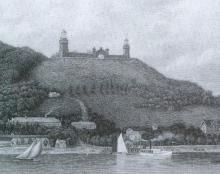
At 260 feet above sea level, the Highlands of Navesink is one of the highest points of land on the Eastern Seaboard of the United States. Overlooking the narrow peninsula of Sandy Hook and being only twenty-six miles from New York City, it was inevitable that the Highlands would become important to the commerce, navigation and defense of that city.
- Read more about The Twin Lights of Navesink
- Log in to post comments