
Port Clinton Lighthouse: Service History Cut Short

Port Clinton, Illinois, was an old forgotten town that was located approximately 12 miles south of Waukegan, Illinois. The entire town was laid out and built by those important entrepreneurs who first settled in this area. They were also responsible for the engineering and building of a 620-foot pier that extended far into Lake Michigan. From all accounts the pier took less than a year to build, and soon there was minor shipping traffic running in and out of the newly formed harbor.
Lighthouses of Chicago Harbor
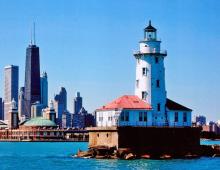
It is difficult to imagine a time when the banks of the Chicago River were lined by scores of tall-masted schooners and steamships. Yet, for the last half of the 19th and into the early 20th century, this river, which trisects the City of Chicago, was home to port operations that made this Midwestern metropolis one of the most commercially important cities in North America. In fact, the historic port of Chicago with its weather-shortened, eight-month shipping season frequently had more arrivals and departures than the year-round ports of New York, Boston, and San Francisco.
- Read more about Lighthouses of Chicago Harbor
- Log in to post comments
Little Traverse Lighthouse
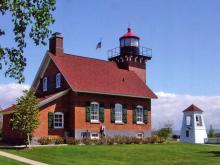
From the earliest days, the northern Lake Michigan shoreline stretching 30 miles south of Waugoshance Point represented an area of incredible natural bounty. It had an endless supply of wildlife and fertile soil. By the 1600s the area supported one of the largest Indian populations to be found anywhere in North America.
- Read more about Little Traverse Lighthouse
- Log in to post comments
The Lighthouse Depots of Lake Michigan: Part 2

In August 2009, I was privileged to attend one of the USLHS's 25th Anniversary dinners that were held around the country, this one in Saint Joseph, Michigan. We toured the old Saint Joseph Supply and Buoy Depot and had several long discussions about the depots and the fact that there was very little information about how they worked, who manned them, and their general history. After the dinner, I resolved to learn what could about the history of these depots.
- Read more about The Lighthouse Depots of Lake Michigan: Part 2
- Log in to post comments
White River Light Station

The western edge of the stateof Michigan was a lush, densely wooded area in the early 1800s. The land was covered by a massive forest of pine and hemlock, and lesser numbers of hardwood trees such as maple and oak. In 1838, Charles Mears built the first sawmill on White Lake, approximately six miles east of the old White Lake Channel to Lake Michigan. This mill used water power cut logs into high grade pine planking. Charles built several mills in the area in the following years, some of which also produced wooden shingles.
- Read more about White River Light Station
- Log in to post comments
The Lighthouses of Illinois

As land hungry American settlers moved west in the nineteenth century they found at their disposal the largest inland transportation system in the world: the Great Lakes. The 94,710 square miles of the Great Lakes contained nearly 20% of the world's fresh water, enough to Cover the continental United States to a depth of ten feet. Some have called the Great Lakes the fresh water Mediterranean of the Western Hemisphere.
- Read more about The Lighthouses of Illinois
- Log in to post comments
Manistee Harbor Lighthouse: Pages from the Past
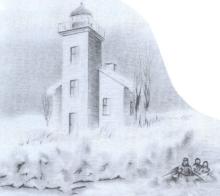
March 19, 1888 -Today at 3:30 p.m. two ladies came to call on Mrs. Roberts and when getting into the boat one of them fell overboard and tipped the boat over and they both got nicely wet. Captain Finch of the station, with the help of his wife and Mrs. Roberts got them out safely. It was blowing a gale from the Southeast and Mrs. Johnson hung on to the boat for about 20 minutes and floated near the mouth of the harbor before we could catch her with another boat. Nothing but clear grit saved her life.
Sand Point Restored

When the U.S. Coast Guard took over operation of aids to navigation from the Lighthouse Service in 1939, changes occurred to the Sand Point Light Station, which has been marking the entrance into Escanaba Harbor on Little Bay du Noquet. The original lighthouse was constructed in 1867 and first lighted on May 13, 1868 The structure was a one-and-a-half story rectangular brick building and an attached brick tower and iron lantern. The 4th order Fresnel lens displayed a fixed red light.
- Read more about Sand Point Restored
- Log in to post comments
Lake Michigan's Grosse Point Light Station

Standing on a 25-foot bluff overlooking Lake Michigan in Evanston, Illinois, the Grosse Point Light Station has served as a guidepost to the lake's traffic in and out of Chicago for over 116 years. Its history reflects the triumphs and tragedies of discovery, trade, and progress which marks the development of our nation's interior.
- Read more about Lake Michigan's Grosse Point Light Station
- Log in to post comments