
I Remember Race Point, MA: Lighthouse Memories
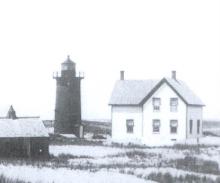
My husband enlisted in the U.S. Coast Guard in January, 1935. During his 23 years of service, he was stationed first on mainland lifeboat stations, later on a weather ship [ed. ocean station vessel], a buoy boat and the Hens and Chickens lightship. My children and I followed him whenever possible which meant he could be home sometimes, but sea duty meant long separations. The Lighthouse Service consolidated with the Coast Guard on July 7, 1939, when civilian lighthouse keepers could either retire or become members of the Coast Guard.
- Read more about I Remember Race Point, MA: Lighthouse Memories
- Log in to post comments
The Great Point Lighthouse Caper: Pages from the Past
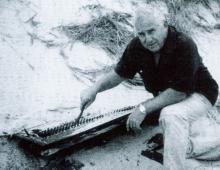
In 1940 I was assigned to the 190 foot buoy tender Anemone, operating out of Woods Hole and New Bedford, Massachusetts. The Coast Guard had just taken over the Lighthouse Service (July 1939) and there were many changes that the members of both services had to become accustomed to. The first assignment I was involved with on the tender was the moving of the Head Keeper of the Great Point Light Station, located on the northeast shorespit of sand on Nantucket Island. The keeper's name escapes me, but I remember him well because of the things that happened and that he was 75 years old.
Landing on the Ledge

Landing on Minot's Ledge is easy enough in summer time when the sea is smooth; but in winter there is hardly a time when the ladder that runs from the foot of the tower to the door forty feet above is of any service. Owing to the particular wash of the waves around the base, it is only on very rare occasions that a boat can tie near the ladder without danger of being swamped or dashed to pieces.
- Read more about Landing on the Ledge
- Log in to post comments
The Second Minots Ledge Lighthouse
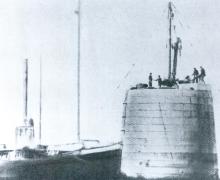
Since storms never cease driving ships on conveninet rocks, the need for at least a temporary light to mark the rocks of Cohasset was clearly indicated. Until a new, permanent tower could be constructed, the government stationed a lightship off Minots Ledge. When the storm of 1851 subsided, the steam tugboat R. B. Forbes was fitted with a temporary illuminant and anchored half a mile north of the Outer Minot in 15 fathoms of water [90 feet] to serve as a lightship. On April 20 another gale blew up of such intensity that the temporary lightship was forced to withdraw into Boston Harbor.
- Read more about The Second Minots Ledge Lighthouse
- Log in to post comments
Minots Ledge
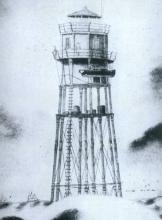
Hobomock, the Evil One according to the local rock Indians, lives under the ledges off the shores of Cohasset and the area north of Scituate, Massachusetts. In his fury, he creates the wild northeast gales that churn the seas into a dreaded maelstrom. To placate him, Indians left gifts on the rocks. The tidal currents in the area cause the rocks to seemingly reach out and grab passing vessels, dragging them to their doom. In the past 350 years, at least a thousand ships, often with entire crews and their cargos, have been lost here.
- Read more about Minots Ledge
- Log in to post comments
Family Tragedy at Cape Poge Light
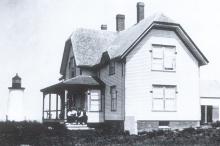
Cape Poge Light was built in 1802, the second lighthouse on Martha's Vineyard. John Adams, our country's second President, signed the order authorizing a light on the northern tip of Chappaquiddick Island. It was more of a navigation aid to Nantucket mariners than Vineyarders. Even today a keeper and family would find it a remote place in which to live year round. Although it is within easy sight of Edgartown, the shire town of the county, before four-wheel-drive vehicles it could be as much as a full days trip to town and back.
- Read more about Family Tragedy at Cape Poge Light
- Log in to post comments
Mayo Beach: Only Yesterday
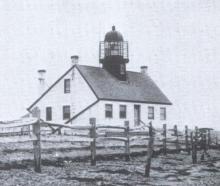
On November 1, 1838, Lt. Edward W. Carpender, USN, submitted a report to Secretary of the Treasury Levi Woodbury on his findings of the condition of several American light stations. The year before, due to a Congressional mandate, he was directed to conduct a survey of the condition of our clighthouses. He spent a considerable amount of time during 1838 traveling the East Coast. In his report he noted, " . . .I was surprised to find a light-house building on Mayo's Beach, at the head of this harbor [Wellfieet], and wrote to you in hopes of arresting the work."
- Read more about Mayo Beach: Only Yesterday
- Log in to post comments
Cape Poge Light: Part 1, Part 2, and Part 3
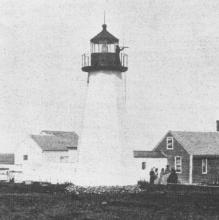
Standing on the extreme northeastern tip of Chappaquiddick Island, Cape Poge Lighthouse, even today, is remote and isolated. In 1801, when the first keeper, Matthew Mayhew, and his family moved into the tiny dwelling provided by a parsimonious Department of the Treasury, it must have seemed as isolated as a frontier outpost. Their enemy was not the "Savage," but the savage sea. Keeper Mayhew felt so insecure that even a quarter of a century later, in 1825, he wrote to Henry Dearborn, Superintendent of Light Houses for Massachusetts: "...
- Read more about Cape Poge Light: Part 1, Part 2, and Part 3
- Log in to post comments
Billingsgate Lighthouse
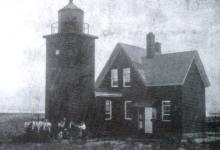
In 1620 the Mayflower found an island of some 60 acres on the north side of Cape Cod. It is said the plentiful bounty of fish in the area caused it to be named Billingsgate after a large fish market in London. At one time the island supported a small community, that included a trying works and the lighthouse, but it's all gone, now that the island has disappeared.
- Read more about Billingsgate Lighthouse
- Log in to post comments
Dumpling Rock: Lighthouse Memories
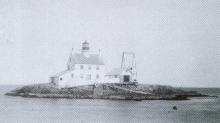
When I was a child my father and mother told me, time and time again, about how they survived the great New England hurricane of 1938. Today, exactly 53 years later, those stories have left me with a legacy of hope. Octave and Emma Ponsart were lighthouse keepers at Dumpling Rock Lighthouse, "a rock in the ocean" as they used to call it, off Padanaram in South Dartmouth. Their story, never before told completely in print, began on that gray Wednesday, Sept. 21, 1938.
- Read more about Dumpling Rock: Lighthouse Memories
- Log in to post comments