A Letter from Montauk Point Light Station: Pages from the Past

Montauk Point Light Station
Montauk, L.I., NY
Nov. 16,1920
Dear Dad,
Your letter arrived today and was sure glad to hear from you. Have moved so many times perhaps your letters haven't caught up with me yet. I surely didn't receive them or I would of answered long before. But I have every reason to believe that I'll be here all winter and although the road is closed during a couple of the worst months, ought to be able to hear from you quite often.
Charlotte-Genesee Lighthouse
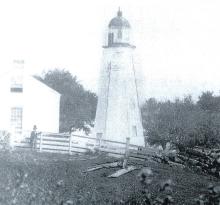
The Port of Genesee was established by President Thomas Jefferson in 1804. The port district stretched approximately 70 miles along Lake Ontario's south shore, from Oak Orchard to Sodus Bay, New York. The port's center was where the north flowing Genesee River met Lake Ontario, a marshy bay guarded by two sand bars. President Jefferson appointed Samuel Latta to be Collector of Customs. In the first year he gathered $22.50 in revenue compared to expenses of $24.00. From that small beginning, the port would grow to be one of the busiest on the south shore of Lake Ontario.
- Read more about Charlotte-Genesee Lighthouse
- Log in to post comments
Montauk Point: Lighthouse Memories
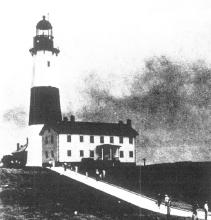
The first lighthouse keeper in our family was my grandfather, John Ninde Buckridge. He had a picturesque career in the Navy and was part of Perry's Expedition to the China Sea and Japan where the Treaty of Friendliness was signed in March, 1854. He was one of three Americans who slept on Japanese soil after the Treaty was signed. His next venture was as a member of the Paraguay Expedition under LCDR Joseph Hull of Saybrook, CT, which took place from 1856 to 1859. Then he served in the Civil War, was injured and had his right leg amputated at the thigh.
- Read more about Montauk Point: Lighthouse Memories
- Log in to post comments
The Lighthouses of Lake Champlain

Many people are amazed when they learn lighthouses exist on the Great Lakes. Geography lessons taught in our nationa's schools appear to have failed to impress upon the students the vast size of the Great Lakes and their importance in the development of our nation. The five major Great Lakes are inland seas, hundreds of miles long, studded with major cities and lined with lighthouses (both Canadian and American).
- Read more about The Lighthouses of Lake Champlain
- Log in to post comments
The Electric Buoys of Gedney's Channel

Buoys have aided the mariner for thousands of years. The Romans anchored compressed reed mats with rope tied to stone anchors to mark channels and harbor entrances. Later, the Flemish and English used wine and beer barrels, anchored with chains and stone sinkers, as buoys. By day, unlighted buoys have been the sign posts of the sea, showing the way around obstructions and into harbors. After 1850 an official color system was codified to enhance the buoys' worth.
- Read more about The Electric Buoys of Gedney's Channel
- Log in to post comments
Shinnecock: Only Yesterday
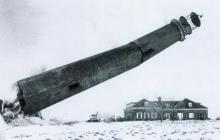
Montauk Point at the tip of Long Island, NY, was the first land sighted by vessels sailing to New York City from Europe, and an important turning point for vessels bound from New England to New York. Recognizing this the federal government constructed a lighthouse at Montauk Point in 1797. To further assist vessels navigate the length of Long Island, another lighthouse was constructed 75 miles west on Fire Island in 1826.
- Read more about Shinnecock: Only Yesterday
- Log in to post comments
Return to Little Gull Island

The harbor was cloaked in an early morning haze as the 28-foot Cape Dory set out for Little Gull Island; it was Ed Whitford's first visit to the lighthouse in nearly 50 years. Ed's father, Edgar M. Whitford, was appointed head keeper of Little Gull Island in October of 1929. The light house, which is located at the eastern end of Long Island Sound and is surrounded by water, had no schools available in the vicinity. Thus, for the most part, the family resided at their Warwick, RI, home and spent only their summers and school vacations at the light station.
- Read more about Return to Little Gull Island
- Log in to post comments
Life on Crossover Island
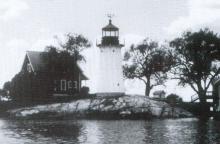
Crossover Island, one of the Thousand Islands, has one thing special about it. It is the only island that is all by itself. It is approximately in the middle of the river between United States and Canada, about 18 miles downstream from Alexandria Bay, N.Y. We never spoke of some thing being North, South, East or West. It was always upstream, downstream the American side or the Canadian side. I have always had a place in my heart for the river and the islands. My father was the keeper on Crossover Island Lighthouse Station from March 1909 until December 1931.
- Read more about Life on Crossover Island
- Log in to post comments
Montauk Point
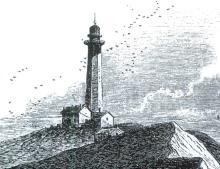
We reached Montauk Light, and the end of our second day's tramp, a little after dark. Later in the evening we accompanied the keeper (Mr. Ripley) on a tour of inspection. Going through a passageway we found ourselves in the oil room, neatly paved with colored tiles, the oil being stored in large tanks on one side of the room. The ascent is by 137 steps, winding around the central shaft and the walls are of enormous thickness; the tower, erected in 1796, was some years since strengthened by building a solid brick lining inside the original structure.
- Read more about Montauk Point
- Log in to post comments
Sands Point Lighthouse
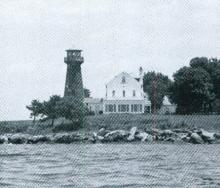
Long Island Sound today is primarily the domain of the yachtsman, but for many years it was an extremely important link between New York City and the ports of New England. It offered a considerable stretch of relatively sheltered water from Block Island to New York. Sailing vessels could avoid the perils of the Atlantic Ocean for this segment of the trip from Boston and other northeastern cities.
- Read more about Sands Point Lighthouse
- Log in to post comments