
The Keeper Had a Horse...and a Mule

No other animal was so useful or critical to the establishment and operation of light stations than the equine. Until the advent of motorized engines, true horsepower (and sometimes mulepower) was the foundation of almost all lighthouse work. Horses and mules carried the first surveyors to lighthouse sites and obediently served the crews who built the stations, hauling materials to construct the towers and working side-by-side with their human counterparts as the light towers and their ancillary buildings rose.
- Read more about The Keeper Had a Horse...and a Mule
- Log in to post comments
Eldred Rock Lighthouse: Alaska's Oldest Original Lighthouse
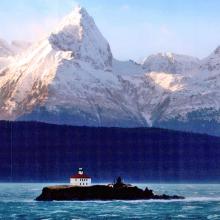
Gold! Its discovery in August 1896 along the Klondike River in Alaska set off the Klondike Gold Rush and spurred construction of coastal towns along the Inside Passage of British Columbia and Alaska. Eventually, the route north was marked with fog signals, buoys, and lighthouses, but not before tragedy and turmoil tainted the story. Death and disappointment came first, followed by struggle and uncertainty. Nowhere are those tales more vividly preserved than in the century-old Eldred Rock Lighthouse.
Point Venus Lighthouse: Memorial to an Antipodean Astronomical Observation

French Polynesia, for all its idyllic beauty and South Seas charm, doesn't seem like a place where cutting-edge science would have been practiced in the 1700s. Like most island paradises, its tranquil, stress-free, untroubled shores beckon those who wish to languish and forget life's serious side.
Grace Darling: Extraordinary Rescuer or Media Heroine?

What lighthouse enthusiast has not heard of Grace Darling, the daughter of an English lighthouse keeper whose pluck and call to duty in 1838 resulted in the rescue of the survivors of the wrecked steamship Forfarshire? Thanks to flowery Victorian journalism and the British bent for fanfare, Grace's single gallant deed earned her immortality and made her, as biographer Jessica Mitford said, "the first media heroine." Yet her story is barely a glimmer these days-not the popular and embellished tale it was more than a century ago.
The Colossus of Rhodes: Yesterday and Today

The late Ken Black, retired Coast Guard Officer and avid collector and exhibiter of all things lighthouse, liked to preface his public talks with an amusing observation: "Lighthouses are like people: they come in all shapes, sizes, and colors." Always offered with a mischievous grin, Black's quip is absolutely true. The world's shorelines are not only made safer by lighthouses but also more beautiful and culturally unique because of the diverse lighthouse designs seen today and throughout history.
- Read more about The Colossus of Rhodes: Yesterday and Today
- Log in to post comments
Poland's Lighthouse of the Geese

Summer on the Polish coastline is typically pleasant-plentiful sunshine and clement breezes off the Baltic Sea, with temperatures in the low 70s. Baltic summers are similar to those of my home in the Pacific Northwest, where days are cool, dry, and sunny. But in July 2010 a heat wave gripped Europe. When it reached Germany, Poland, and Russia it stalled for several weeks, driving temperatures into the high 90s. The unseasonable spate of hot days happened to coincide with a U.S. Lighthouse Society tour of Poland's lighthouses.
- Read more about Poland's Lighthouse of the Geese
- Log in to post comments
A Visit to the Lighthouses of the Baltic Gibraltar
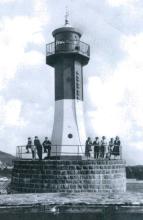
Rugen Island, Germany's largest island, lies at the country's northeast corner surrounded by the chilly waters of the Baltic Sea and stunning seascapes that are part of the western reach of the Polish-German "Pomeranian Coast." The sunny isle is named for an old Slavic tribe known as the Ranen, which possibly means "The Reds," for the color of their hair. Their land eventually became known as the Rugard. But modern-day Germans simply call it "The Baltic Gibraltar."
The Lighthouse at West Point Military Academy

Long before cities and ports were established along the Hudson River's twisting 315-mile route from the Atlantic Ocean to its source in the Adirondack Mountains, its strategic value was recognized. Henry Hudson, for whom the river is named, sailed along the shores of present-day Manhattan in September 1609 seeking the fabled Northwest Passage. His voyage, which took him as far north as the area around Albany, was financed by the Dutch East India Company.
- Read more about The Lighthouse at West Point Military Academy
- Log in to post comments
Howland Island Lighthouse: A Light for Amelia Earhart

The vast Pacific Ocean is home to numerous groups of islands, some so tiny, far-flung, and isolated that many of us have never heard of them. Howland Island, a mere sandbank adrift in cerulean seas and distant from civilization, might fit that description, except for the fact that it gained fame 75 summers ago when it played a significant role in the disappearance of America's most famous aviatrix.
Sojourn at Kakokefali Lighthouse

Late in the day, the April wind swept in from the Gulf of Evia and wrapped its clamorous arms around the old stonework of the lighthouse. The closed heavy green shutters on the north windows of the structure rattled forcefully, as if at any moment they might leap off their hinges and disappear into the dark water below. I held my hand against the window next to my bunk and felt the cold air sneaking in around the frame. An errant tree limb scratched the outside wall like a visitor asking to be let in, and something banged in the tower 39-feet above me.
- Read more about Sojourn at Kakokefali Lighthouse
- Log in to post comments