Lighthouses of China

From 1863 to 1911, Robert Hart was the Grand Guardian of the Heir Apparent China, as well as Inspector General of Chinese Maritime Customs. He was appointed to this post by the Chinese government to supervise the collection of Customs duties on the growing foreign trade in China. During his tenure he also organized the National Postal Service and the Lighthouse Service.
- Read more about Lighthouses of China
- Log in to post comments
Spurn Point Lighthouse
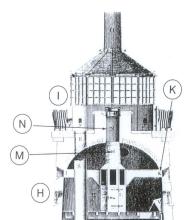
In 1676 a patent was granted by King Charles June II to Justinian Angell, a London Merchant, to allow him to continue, rebuild and maintain certain navigational lights he had erected upon Spurn Point to assist navigation along the coast and into the Humber River. Vessel losses had become so numerous, especially at night, that masters of merchant vessels contacted the owner of Spurn Point, Mr. Angell, and beseeched him to erect lights on his land to benefit vessels passing the area. The lights warned mariners of a sand bar which had formed out into the Humber River.
- Read more about Spurn Point Lighthouse
- Log in to post comments
The Electric Buoys of Gedney's Channel

Buoys have aided the mariner for thousands of years. The Romans anchored compressed reed mats with rope tied to stone anchors to mark channels and harbor entrances. Later, the Flemish and English used wine and beer barrels, anchored with chains and stone sinkers, as buoys. By day, unlighted buoys have been the sign posts of the sea, showing the way around obstructions and into harbors. After 1850 an official color system was codified to enhance the buoys' worth.
- Read more about The Electric Buoys of Gedney's Channel
- Log in to post comments
Ken Black and the Shore Village Museum

Ken Black likes to say, "There are believers and nonbelievers." By 'believer' Ken is talking about those among us who have a love of lighthouses, light ships, aids to navigation artifacts and the associated lore. Believers are people who believe that those elements of our maritime heritage are worth saving for future generations to know and enjoy. Nonbelievers are, well, let's just say, lacking vision.
- Read more about Ken Black and the Shore Village Museum
- Log in to post comments
A Lighthouse for the Isle of Guernsey
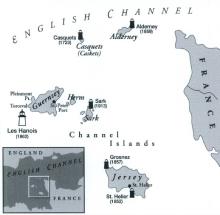
People often say that 'It's the squeaky wheel that gets the grease.' The squeaky wheel on the Isle of Guernsey in the year of 1846 was one Captain W. Sadler of the steam packet Sir Francis Drake. This tenacious mariner was adamant for the need of a lighthouse on the island of Guernsey and in his fervor proved a Royal thorn in the side of Trinity House, the organization charged with the responsibility of British lighthouses. Guernsey is one of the Channel Islands belonging to Great Britain but located close to France rather than near the English coast.
- Read more about A Lighthouse for the Isle of Guernsey
- Log in to post comments
The Lightships of Nantucket Shoals

For 163 years, between, 1820 and 1983, our government employed lightships to mark dangerous shoals and harbor entrances. They were placed in locations where was impractical to construct a lighthouse. The first three lightships, more boats ships, were established in the lower Chesapeake Bay in 1820. Over the years more more lightship stations were established. The heyday of lightships in this country was 1915, when 76 vessels were designated to mark 55 stations.
- Read more about The Lightships of Nantucket Shoals
- Log in to post comments
The Nantucket Shoals Lightship Station
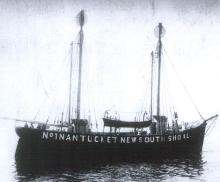
For 163 years, from 1820 to 1983, our government employed lightships to mark dangerous shoals or signal the entrances to harbors, rivers, and bays. They were placed in locations where it was impractical to construct a lighthouse. The first three lightship stations were established in lower Chesapeake Bay around 1820. They were more boats than ships, small vessels without sails that were towed to a location and anchored. Over the years more and more lightship stations were established. The Sandy Hook station off New Jersey, created in 1823, was the first "outside" station.
- Read more about The Nantucket Shoals Lightship Station
- Log in to post comments
The Cape Hatteras Lightship

The lighthouse, with its reflector system of illumination, was not adequate for the job of warning mariners who navigated the Diamond Shoals, located 8 or 10 miles off-shore. Blunt's American Coast Pilot describes the area in his 1803 edition, "Cape Hatteras is the most remarkable and dangerous cape on the coast of North America.
- Read more about The Cape Hatteras Lightship
- Log in to post comments
Cape Charles Lightship

In 1888, to assist mariners find the entrance to Chesapeake Bay, the Lighthouse Service established a lightship station east of Smith's Island (and the Cape Charles Lighthouse). The 1888 Report to Congress reads, "Cape Charles Light-ship, No. 46, off the entrance to Chesapeake Bay, Virginia - This vessel was placed in position just outside of Smith's Island Shoal on February 17, 1888. She has ridden out several heavy gales and proved herself an excellent sea-boat and a valuable aid to the navigation of the coast."
- Read more about Cape Charles Lightship
- Log in to post comments
The Lighthouses of Puerto Rico (Parts 1 & 2)
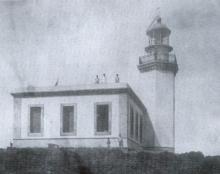
Columbus visited Puerto Rico during his second voyage to the New World (17 to 22 November, 1493) and dubbed it San Juan Bautista (although it was called Borinquin by the natives). In 1508 the Governor of Haiti rewarded the services of Juan Ponce de Leon, who had accompanied Columbus during his 2nd voyage, by permitting him to explore the island in search of gold.
- Read more about The Lighthouses of Puerto Rico (Parts 1 & 2)
- Log in to post comments