
When most people think of lighthouses they think of the words security, serenity and dependability. And they usually think of the Keeper, affectionately called "wickie", as a man. Perhaps a seafaring type now retired from treks "round the horn" faithfully tending to the myriad duties necessary to successfully operate a lighthouse. However, that vision was in numerous cases incorrect, for many keepers were women.

During the years of manned light stations in America several women served as keepers. Almost all of them obtained the position due to their husbands becoming incapacitated or dying. For the greater part of 140 years, the Turkey Point Light Station in Maryland was under the care of women, many of whom were related.

Mary Jane (Belknap) Fiester/Vail/Adams was one of the first white women to settle in the Oregon Territory. She outlived three husbands, operated on a mans eyes, and was the assistant keeper at the Smith Island and Cape Flattery Light Stations. She was born Jane Belknap in 1822. At the age of 17 she left her native Ohio for Illinois where she met and married Henry Fiesten. Henry was a skilled tailor who moved from town to town always seeking a more affluent life. Jane became used to the itinerant life.

A dark brooding sky greeted the morning, and the birds that lived in the majestic, moss-draped oaks that usually saluted the day were quiet as though they sensed that something ominous was about to happen. Occasionally breezes stirred the blossoms of the magnolia trees growing on the boggy shore of the Biloxi Peninsula of Mississippi, but were unable to relieve the hot, humid weather. Gradually the breezes gave way to high winds coming off the Gulf of Mexico, and the waves that usually caressed the shore at the foot of the lighthouse began to increase in size.

About 1876, the Lighthouse Service decided it would be a good idea to provide a small library at isolated stations to improve morale. The Annual Report of that year States, "During the past year the board has collected fifty small libraries, consisting of about 40 volumes each, for use at the more isolated light stations. It is intended that each library remain about six months at a place, when it will be exchanged for another."

The Lighthouse Board stated in 1883, “It is believed that uniforming the personnel of the service, some 1,600 in number, will aid in maintaining its discipline, increase its efficiency, raise its tone, and add to the esprit de corps.”

Our first lighthouse keeper, George Worthylake, was paid £50 a year. He was appointed keeper of the Boston Lighthouse on Little Brewster Island in 1716 by order of the general court of the Province of Massachusetts Bay. Adjusting for inflation and converting British pounds into American dollars, the 50£ is worth about $7,732 today. Of course, he had the use of a dwelling and government land and his expenses were few, no automobile to buy and maintain, no telephone, electricity, etc.
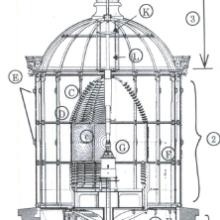
Certainly the most important aspect of the lighthouse to the mariner is the light that emanates from the tower. Many people have remarked "oh what a beautiful light!" (when they meant tower or lighthouse), sometimes people say such and such a station has a beautiful light made in France (when they are really talking about the lens). As long as we are going to discuss lighthouses, lets use the correct terms. The lantern room is that portion of the top of a lighthouse tower that encloses the lens.

The story of the lighthouse at Volusia Bar begins and ends with FIorida's St. Johns River. Originating in the Fellsmere Swamp southwest of Vero Beach, the St. Johns is one of only a few United States rivers that flow north. The St. Johns is unique in that it flows north to empty into an ocean, the Atlantic, at Jacksonville. Over 300 miles long, the St. Johns has been a crucial transportation route since prehistoric times when native peoples used dugout canoes to travel its length. As Florida's longest river, it was, and continues to be, instrumental in the development of the state.

Long before cities and ports were established along the Hudson River's twisting 315-mile route from the Atlantic Ocean to its source in the Adirondack Mountains, its strategic value was recognized. Henry Hudson, for whom the river is named, sailed along the shores of present-day Manhattan in September 1609 seeking the fabled Northwest Passage. His voyage, which took him as far north as the area around Albany, was financed by the Dutch East India Company.