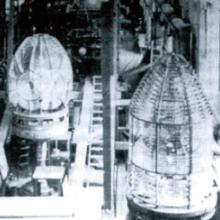
This is a continuation of the story of the Fresnel lens makers. In this article, the Chance Brothers Company in England is described from its beginning as a glass window maker to its production of Fresnel lenses for the world market, and to its final demise after being bought out and divided into several companies.

This is a continuation of the story of the Fresnel lens makers. In this article the Barbier, B6nard and Turenne (BBT) Company in France is described from its beginnings as a Fresnel lens maker for the world market, to its final demise when it was broken and merged into several other companies.
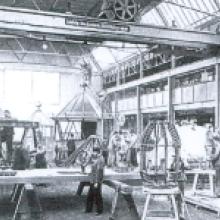
This is the final segment of the story of the Fresnel lens makers. In this article the AGA, Pharos Marine, Automatic Power, Corning, Macbeth-Evans, Gebr. Picht, Dr. Genthe Glass, Nitsche & Gunther, Julius Pintsch, Wilhelm Weule glass and lens makers described. There are a number of other makers of navigation aids that have not been included in this series of articles because they did not produce glass Fresnel lenses.
Situated along the south coast of the English Isle is the Port of Plymouth. Always a strategically located seaport, it gained further importance during England's expansion of trade in the 17th century. During this period Plymouth continued to play host to the Royal Navy, realized a sizable mercantile fleet and doubled its population. Except for one reason a great many mariners considered Plymouth to be one of the world's greatest harbors.
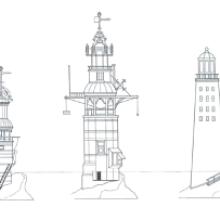
A few nights after the destruction of Henry Winstanley's lighthouse a merchantman, the Winchelsea, arrived at the southern coast of England. She was loaded with tobacco from Virginia and had weathered the terrible storm that engulfed southern England a few days earlier.
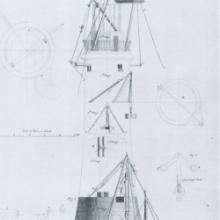
The Eddystone had twice resisted attempts of man to conquer the reef. Now it is John Smeaton's turn with a lighthouse of stone. The taming of the Eddystone is at hand.

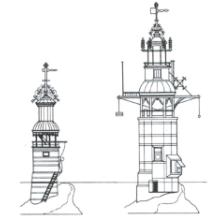
In previous issues we related the tales of the first three lighthouses to occupy the Eddystone. The first, Henry Winstanley's whimsical structure, was completed in 1699 and destroyed by a storm in 1703. Next came John Rudyard's sleek wooden tower. Completed in 1706 it succumbed to fire in 1754. John Smeaton parted with tradition and built the first stone tower on wave swept rock completing the structure in 1759. And, now, the final chapter in the story of the Eddystone, James Douglass's magnificent tower of granite.
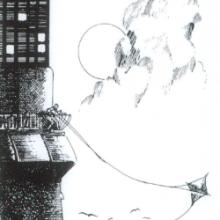
The sea is round. A quivering disc far below and, when there is no moon, tar-black except when there splayed lines of rock gash the waters into whiteness and the spray flies upward like smoke from an explosion. This is the center of a private world where all is round, so round that after a time it can daze and bemuse the senses into a raving for a single angle or straight line. The beams of light, six pairs of them equidistantly spaced, reach down the horizon and, sweeping smoothly round it, sever the sea from the ocean beyond.
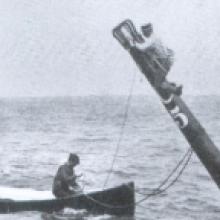
Buoys have aided the mariner for thousands of years. The Romans anchored compressed reed mats with rope tied to stone anchors to mark channels and harbor entrances. Later, the Flemish and English used wine and beer barrels, anchored with chains and stone sinkers, as buoys. By day, unlighted buoys have been the sign posts of the sea, showing the way around obstructions and into harbors. After 1850 an official color system was codified to enhance the buoys' worth.
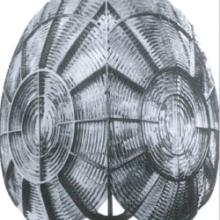
In 1813 Augustine Fresnel devised the division of the central bulls eye refracting glass into separate angular units capable of being arranged to utilise rays from the oil lamp burners available at that time to produce beams of light as a signal from lighthouses and beacons.