The Early Development of the Fresnel Lens: Part 4 (Chance Brothers)
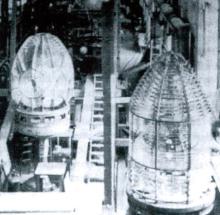
This is a continuation of the story of the Fresnel lens makers. In this article, the Chance Brothers Company in England is described from its beginning as a glass window maker to its production of Fresnel lenses for the world market, and to its final demise after being bought out and divided into several companies.
The Early Development of the Fresnel Lens: Part 3 (Henry-Lepaute)
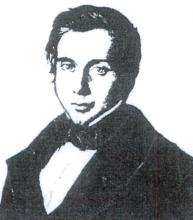
The founder of the Lepaute dynasty of clockmakers was Jean Andre Paute, born in 1720 in Thonne-la-Long, France. He was the son of Andre Paute, blacksmith and maker of plows. Andre Paute had nine conchildren and two of his sons were Jean Andre Paute and Jean Baptist Paute.
The Early Development of the Fresnel Lens: Part 2 (Louis Sautter)

Louis Sautter (pronounced So-tay) completed engineering school at the Central School of Arts and Manufactures in 1846. Helped by one backer, Fernand Raoul-Duval, Sautter entered the navigation aids business in 1852, when he assumed ownership and management of the company that would carry his name. The business was previously wwned by Francois Soleil Sr., which by this time had passed from him to his son-in-law Jean Jacques Francois and ultimately to Francois' son-in- law Theodore Letourneau. The factory was then located at 37 Avenue Montaigne on the Champs-Elysees in Paris.
The Early Development of the Fresnel Lens: Part 1 (Augustin Fresnel)
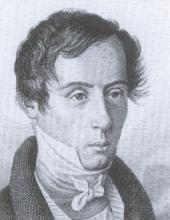
Many companies were involved in the development and refinement of the Fresnel lens. Some supplied only the glass for the lenses, either in rough form, or both cast and polished. Other companies assembled the glass elements and performed finish work on the lens elements. Still other companies produced both the glass and the finished lenses. This story will be divided into several parts, each discussing one or more of these companies and their contribution to the development of the Fresnel lens.
Silver Creek and Cattaraugus Creek
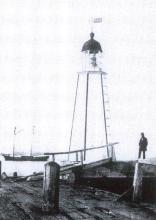
I was on a trip through western New York State on my way to a lighthouse meeting in Buffalo. Being a lighthouse enthusiast, I was driving along the road nearest to the edge of Lake Erie and not on the New York Thruway. As I traveled east I came to the tiny town of Silver Creek and seeing the name triggered a thought that I had once seen reference to there being a lighthouse or beacon located here sometime back in the early 1800s.
- Read more about Silver Creek and Cattaraugus Creek
- Log in to post comments
Who Invented the Fresnel Lens?

One might think this is a trick question, similar to "Who's buried in Granet's Tomb " There really was a question about the inventor of the famous lighthouse lens. From 1822, when Augustin Fresnel first published his paper Memoire sur un Nouveau Systeme d'Eclairage des Phares, Sir David Brewster, in Scotland, claimed that he was the true inventor, and his claims were not fully resolved until after his death in 1868. This story will discuss the various claims made by Brewster and the counter arguments made by Alan, David, Thomas Stevenson and others.
- Read more about Who Invented the Fresnel Lens?
- Log in to post comments
From Braziers and Bougies to Xenon: Part III
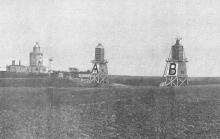
One of the first lamps burning gasified oil was developed by Nyberg and Lyth in Sweden 1881. It worked by vaporizing colza oil and burning it without a mantle as a Bunsen burner does. However, this type of lamp was not efficient at producing additional light output. The next step was the addition of the incandescent gas mantle invented by Carl Auer von Welsbach, in Vienna, in 1885. This led to the first crude kerosene Incandescent Oil Vapor lamp, which was installed at the L'Ile Penfret lighthouse, by the French, in 898.
- Read more about From Braziers and Bougies to Xenon: Part III
- Log in to post comments
From Braziers and Bougies to Xenon: Part II

In 1836, Monsieur Franchot invented the Moderator lamp where a spiral spring operated piston made oil flow to the wicks through constricted valve known as the moderator. These lamps were used in most fixed lenses in France, and in America when Fresnel lenses were first installed during the 1850s. However, they were not used in American lighthouses after about 1865.
- Read more about From Braziers and Bougies to Xenon: Part II
- Log in to post comments
From Braziers and Bougies to Xenon: Part I
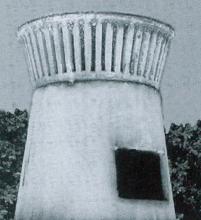
The early mariner's warning lights consisted chiefly of open fires and later of fire beacons maintained on a grate or in an iron basket known as a brazier and shown from an elevated location or platform near the coast. They were often unreliable because of the variability between burning well, with lots flame and therefore light, or burning poorly with little flame or much smoke obscuring the light. These beacons were maintained both by public and private enterprises. Patents were granted to certain individuals for the upkeep of beacons in England and Scotland.
- Read more about From Braziers and Bougies to Xenon: Part I
- Log in to post comments
The Genius and the Mentor
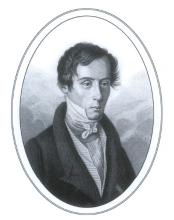
France had reached a high level of sophistication in the 1790s, especially in the sciences. It was in 1794, that Lazare Carnot, then a high government official, established a very special school for the best scholars within the country. The original name of the school was 'Ecole Centrale des Travaux Publique,' but its name was changed to'Ecole polytechnique' in the following year. The Ecole Polytechnique was under the supervision ofthe Ministry of Defense and was the best technical school in France.
- Read more about The Genius and the Mentor
- Log in to post comments