
St. Augustine Lighthouse

Inspired by West Indian tales of gold and a fountain giving perpetual youth, Juan Ponce de Leon, Spanish Governor of Puerto Rico, reached Florida's eastern shore on April 2, 1513. He landed between (what are now called) the St. Augustine Inlet and the St. John's River. He claimed the land for Spain and named it "La Florida", land of the flowers. In 1564 when French Huguenots established Fort Caroline, five miles from the mouth of the St. John's River, King Philip of Spain sent Pedro Menendez de Aviles with an expedition against the colony.
- Read more about St. Augustine Lighthouse
- Log in to post comments
Gay Head Lighthouse

It was a Nantucket Politican, Peleg Coffin, Esq., who in 1796 wrote to his Congressman in Washington suggesting that "the convenience and interest of Nantucket" would be promoted if the Federal Government would build a lighthouse at Gay Head. Nobody on the Vineyard seemed interested.
- Read more about Gay Head Lighthouse
- Log in to post comments
Point Iroquois - Lighthouse Memories (Spring)
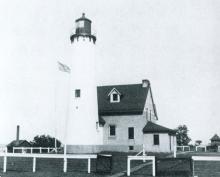
The first sign of Spring at the lighthouse was flocks of large, black, ragged-winged birds: squalling, squawking and squabbling against the blue March sky and white patches of snow. The crows had come back.
- Read more about Point Iroquois - Lighthouse Memories (Spring)
- Log in to post comments
Navassa Lighthouse
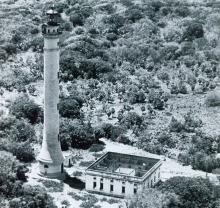
"Navassa Island Light, where chickens only miraculously survive the attacks of lizards." Thus began the description of life at the Navassa Island lighthouse in a letter dated July 18, 1923 by F.P. Dillion. Dillion, Superintendent of the Ninth Lighthouse District (Puerto Rico and nearby US. Islands), was desperately trying to solve the personnel problem at that station.
- Read more about Navassa Lighthouse
- Log in to post comments
The Isle of May – Scotland's first Lighthouse

On a bitterly cold morning in January 1791 Henry Dowie, Assistant Keeper of teh Isle fo May Lighthouse, descended the stairs from the roof of the structure at the end of his watch. He had been assigned the last watch of the night, roughly from 2 a.m. until sun up. He had spent a rigorous night tending the open coal fire. In fact he could remember few nights as miserable as this one had been. The bitter cold and strong wind demanded that he shovel 400 pounds of coal an hour into the coal grate.
- Read more about The Isle of May – Scotland's first Lighthouse
- Log in to post comments
Point Iroquois – Lighthouse Memories (Winter)

After the rivers connecting the Great Lakes froze, all lake traffic came to a halt. The keepers and their families settled in for the long cold winter. All painting and repairs to lighthouses was confined to interior areas. In the mornings, an hour before school started, my father would build a coal fire in the pot-bellied stove in our little school house. Weekends, the teacher would be driven across the ice to Brimley by car where she would take the train to the Soo.
- Read more about Point Iroquois – Lighthouse Memories (Winter)
- Log in to post comments