The Lighthouse Keepers of Eilean Mor
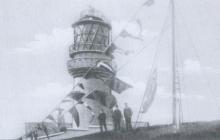
The Flannan Isles are a group of seven uninhabited islands, part of the Outer Hebrides chain off the coast of Scotland. The largest of the seven-also called the Seven Hunters-is called Eilean Mor, which in Scots Gaelic means, simply, "Big Island." It is not so very big; it covers a grand total of 37 acres.
- Read more about The Lighthouse Keepers of Eilean Mor
- Log in to post comments
The Nose of the North

Along the far north coast of Scotland, you will find the small town of Wick, population about 8,000. The town is very old and forms a part of the land originally owned by the Clan Sinclair one of the oldest Scottish Clans. This area is also steeped in the history of the Stevenson family lightbouse engineers. Robert visited the area many times and was the first to look at the possibility of erecting a lighthouse there. It was left to his son Alan to construct the first lighthouse in the area.
- Read more about The Nose of the North
- Log in to post comments
Dhu Heartach Lighthouse: A Scottish Lighthouse by The Stevensons
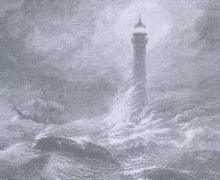
The tiny islet which is the Dhu Heartach (also spelled Dubh Artach, pronounced "Doo Artacc") lies 15 miles southwest from the Isle of Mull, Scotland and is the furthest outcropping of a reef known as the Torren Rocks. Over the years, most mariners, knowing the danger of the Torren Reef and giving it a wide berth, found themselves snared by Dhu Heartach. A desolate group of rocks, Dhu Heartach lies 20 miles southeast of a similar rock called Skerryvore. The Dhu Heartach consists of the main rock, five detached tide-covered hummocks, and two small sunken rocks.
The Calf of Man Lighthouses 1819

The Isle of Man is often described as the rock in the middle of the Irish Sea. This may geographically be so, but it is also home to some 70,000 people. The natural beauty of the island abounds, with mountains in the centre, lush agricultural land in the north, a rugged and remote coastline in the south and west. The Isle of Man is only some 30 miles from tip to toe and 11 miles wide. On the south western tip of the Isle of Man lies a small island known as the Calf of Man. Today the Calf is occupied from March to October by two wardens who are employed by Manx National Heritage.
- Read more about The Calf of Man Lighthouses 1819
- Log in to post comments
Scurdyness Lighthouse

The entrance to the harbor estuary at Montrose has long presented problems to seamen. Thus in 1547, Alexander Lindsay, pilot to the Navigation on King James V warned "If you would enter the haven of Montrosehold to the southside of the entry, so you shall shun a bank of sand." Again in 1693 in Captain Greenville Collin's 'Great Britain's Coastal Pilot' there is a map of 'The Sea Coast from Fyffness to Montrose surveyed by Mr. Mar, an ingenious mariner of Dundee.' The coastline around Montrose is depicted and there are clear directions for navigating the river.
- Read more about Scurdyness Lighthouse
- Log in to post comments
Skerryvore Lighthouse
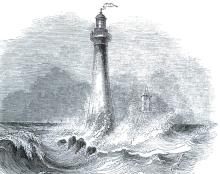
Most of you Americans are probably more acquainted with my nephew Robert Louis Stevenson than you are with my father. But my father, Robert Stevenson, is Considered one of the most famous engineers in the world; he built lighthouses. His most famous work was the Bell Rock off the east coast of Scotland, which he finished m 1810. Many have stated that it is one of the ten most important lighthouse constructions in the world. Building that tower was an arduous and ingenious work.
- Read more about Skerryvore Lighthouse
- Log in to post comments
A Lighthouse for Bell Rock (Part 1)
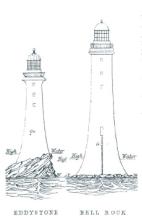
My father died of a fever in the West Indies when I was but two, that was in 1774 and mother and I were living in Glasgow. A short while later she married a wealthy man named James Hogg, but I don't remember him and mother never talked about him. I don't know whether he died or they were divorced, rather the latter I think. Anyway, mother managed to provide for our welfare after a fashion and with a lot of church going which always gave her strength. She managed well enough to enroll me in the Royal High School, hoping that I would eventually become a minister in the Church of Scotland.
- Read more about A Lighthouse for Bell Rock (Part 1)
- Log in to post comments
A Lighthouse for Bell Rock (Part 2)

I bent and scooped a handful of sea water from a crevice. It was most foul tasting, but it did restore moisture to my mouth. I rose to speak and tell the men of the only plan that I had been able to formulate when someone (I think it was the smith's assistant, Mac Leash), called out, "A BOAT, BOAT!" I turned and sure enough t'was either a mirage or a miracle. I could discern a large boat making her way through the haze toward us. The timely visitor was the Bell Rock pilot, James Spink, who had come to deliver letters.
- Read more about A Lighthouse for Bell Rock (Part 2)
- Log in to post comments
The Isle of May – Scotland's first Lighthouse

On a bitterly cold morning in January 1791 Henry Dowie, Assistant Keeper of teh Isle fo May Lighthouse, descended the stairs from the roof of the structure at the end of his watch. He had been assigned the last watch of the night, roughly from 2 a.m. until sun up. He had spent a rigorous night tending the open coal fire. In fact he could remember few nights as miserable as this one had been. The bitter cold and strong wind demanded that he shovel 400 pounds of coal an hour into the coal grate.
- Read more about The Isle of May – Scotland's first Lighthouse
- Log in to post comments