
Growing Up at Point Loma Light Station during World War II
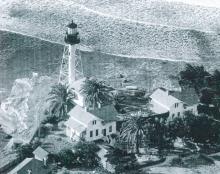
It was wonderful growing up at the lighthouse. I was pushing three years old when we moved to Point Loma in 1931. Dad had been assistant keeper at the Farrallon Islands [off San Francisco]. Every child should have the opportunity to live at a lighthouse. It was sometimes lonely. [She had no siblings.] I learned to enjoy my own company. Mom loved living on the Point. Dad liked being a keeper, too. The work wasn't real hard, but it was long hours. A keeper has to be a jack-of-all-trades - carpenter, mechanic, painter, you name it, and be able to polish brass!
Legacy of the Carrier Pigeon: A History of the Pigeon Point Light Station
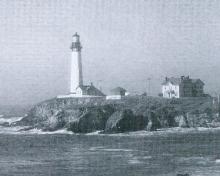
The decade of the 1850s could well be called the"Age of the Clipper." They were the sleekest and swiftest of merchant sailing vessels. The Carrier Pigeon measured 175 feet long and just 34 feet wide. She was rated at about 845 tons burden and had a beautiful gilded pigeon as a figurehead. Launched from the shipyards at Bath, Maine, in the fall of 1852, the Carrier Pigeon departed Boston on her maiden voyage January 28, 1853. The ship took the waves with ease as she rounded Cape Horn and sailed north along the western edge of the Americas toward San Francisco.
Humboldt Harbor Lighthouse: Only Yesterday
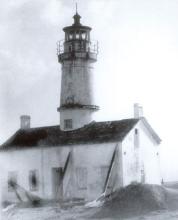
The population explosion of San Francisco and central California due to the Gold Rush created a tremendous demand for lumber to construct new houses and commercial buildings. Although there were lumber trees in the Bay Area and up in the Sierras, the tall redwood and Douglas fir trees in the Humboldt Bay area provided the most abundant and economical supply. The Bar Channel into Humboldt Bay is as dangerous as any on the west coast, but the Bay is broad and fairly sheltered.
- Read more about Humboldt Harbor Lighthouse: Only Yesterday
- Log in to post comments
Mare Island Light Station: Only Yesterday
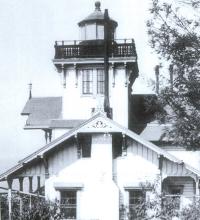
By the 1870's San Francisco Bay was teeming with ship traffic. Vessels arriving from other states and foreign lands called at the Port of San Francisco and the inland ports of Sacramento, Stockton and other inland cities. The increase in vessel traffic necessitated more aids to navigation along the waterways. One site was at the confluence of San Pablo Bay and Mare Island Strait.
- Read more about Mare Island Light Station: Only Yesterday
- Log in to post comments
Ballast Point: Only Yesterday
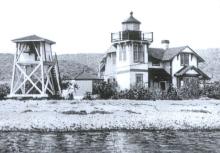
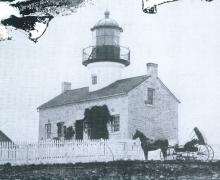
In 1855 the Lighthouse Service constructed the first Point Loma Light Station high on a bluff to mark the entrance to San Diego Harbor. The location was thought to serve two purposes: 1) show the entrance to San Diego Harbor, and 2) act as a seacoast light to help vessels fix their position. In actuality, it served neither. It was too far from the channel into San Diego Harbor to help vessels navigate the narrow channel and it was too high to be of use to vessels sailing offshore as layers of low coastal fog obscured the light.
- Read more about Ballast Point: Only Yesterday
- Log in to post comments
Point Bonita Light Station

The discovery of gold at Sutter's Mill in 1848 changed San Francisco from a sleepy village to a boomtown, seemingly overnight. The thousands of ships bringing Easterners to the gold fields caused San Francisco Bay to become a forest of masts as crews abandoned their ships for the promise of fortune in the Sierras.
- Read more about Point Bonita Light Station
- Log in to post comments
Humboldt Bay Memories
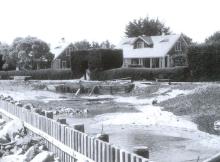
Our recruit training at the Coast Guard facility on Government Island, near Alameda, California, was completed in early 1954. We were standing in formation in front of our barracks. A yeoman came from the office and handed out duty assignments. He said, "Raube, we need someone at the Humboldt Bay Light Attendant Station near Eureka. Would you like that? I said that would be great.
- Read more about Humboldt Bay Memories
- Log in to post comments
Something New at the Old Point Loma Lighthouse
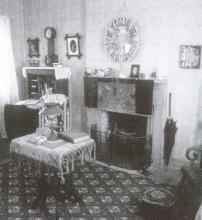
In the 1981 Point Loma Historic Structures Report, park Historian Ross Holland described the activity: "From the historic record and the building itself, the architects learned a great deal and they began to restore the building to what they thought was its original condition. Rotten wood was replaced, the lean-to was rebuilt, the flooring was renewed throughout, and the metal lantern crowning the tower was reconstructed. Certain modern concessions were made because of the intended use of the building. Electric fixtures were installed, as was plumbing."
- Read more about Something New at the Old Point Loma Lighthouse
- Log in to post comments
Old Point Loma
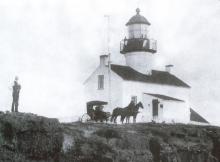
The 1850s were a period of flux for the nation's aid to navigation systems. During the 1850s, the Lighthouse Board replaced the inept 5th Auditor of the Treasury and brought about a change of rules and regulations. Keepers of light stations now had to be able to read and write, something which wasn't required under the old regime. The new board also modernized the system of aids to navigation in this country. One of the most important changes was the introduction of the Fresnel lens which had been invented in 1822 and installed in most maritime country's light stations.
- Read more about Old Point Loma
- Log in to post comments
1852: Dark Clouds Over The Pacific Coast Lighthouses - Part 1
March 1, 1850 was a damp, cold day in the District of Columbia. The clouds were darker gray than usual and because the sun did not appear. This was the inauguration day of Millard Fillmore as the thirteenth President of the United States. At the Department of the Treasury the fires were banked in the fireplaces in the ornate offices, the window drapes were drawn, and the doors were locked.