Currituck Beach Light Station
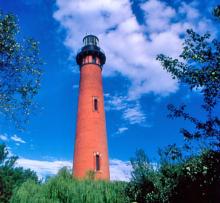
The feeling of quietude within the Currituck Beach Lighthouse complex is quickened by undertones of excitement as visitors anticipate climbing all the way up the towering lighthouse's spiral stairs and taking in an unforgettable panoramic view. This histonc northern Outer Banks site is steeped in history, architecture, romance, and mystery. Besides offering some of the best aerobics on the East Coast by climbing the tower, the Currituck Beach Light Station is part of an authentic living-history district.
- Read more about Currituck Beach Light Station
- Log in to post comments
Cape Lookout Lighthouse

Standing on "Shell Point," a spit of land at the tip of Harkers Island, one is embraced by the waters of Core Sound. Looking southeast, the Cape Lookout Lighthouse stands in solitude across a marsh-studded sound on South Core Banks, overlooking Lookout Bight on the west and the Atlantic Ocean to the east. These waters have carried the great people who have lived here: lighthouse keepers, life-saving surfmen, boatwrights, fishermen, net makers, whalers, and all those who formed independent communities that made a living from the sea.
- Read more about Cape Lookout Lighthouse
- Log in to post comments
Bodie Island Light Station: The Light No Captain Could Afford To Miss

The 1872 Bodie Island Lighthouse joined a valued network of navigational aids that guided mariners along an otherwise featureless and tricky coastline of North Carolina. The site was significant as witnessed in efforts by the U.S. Lighthouse Service that built three towers to mark the immediate area between 1848 and 1872. The first tower Was completed in 1848 but rendered useless due to an inadequate foundation; the second tower was built in 1859 but fell victim to the War Between the States in 1861.
Still Standing Tall: A History of Methods Used to Protect the Cape Hatteras Lighthouse
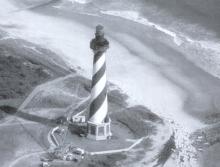
Since its completion in 1870, the Cape Hatteras Lighthouse on the coast of North Carolina has lit the way for thousands of mariners as they skirted around the dangerous Diamond Shoals off the Outer Banks. Lights and beacons have been used on the North Carolina coast since the early 1700's to guide ships as this was the principal area by which commerce entered the state. As commerce increased, the Diamond Shoals gained a reputation as the "Graveyard of the Atlantic" over 600 ships have been lost in the area over the last 400 years.
Cape Hatteras!
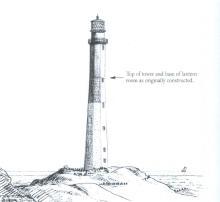
A long and very thin strip of land stretches south 175 miles along North Carolina's eastern shore. This barrier island, which is actually a series of islands, is known as the Outer Banks. These barrier islands migrate, constantly changing shape as they are affected by storms, ocean currents and even wind. During heavy winter storms the area can erode, only to accrete during the summer months. The Outer Banks is separated from the mainland by broad, shallow sounds and are occasionally breached by narrow inlets which open and close due to storms.
- Read more about Cape Hatteras!
- Log in to post comments
Ocracoke Lighthouse: A History of North Carolina's Oldest Operational Lighthouse

Nearing its 175th birthday, the Ocracoke Lighthouse continues to provide a sense of security and continuity to the 800 or so permanent residents of Ocracoke Village, located on the Outer Banks of North Carolina. Ocracoke Lighthouse is the oldest operational lighthouse in North Carolina, constructed in 1823. Only Bald Head Island Lighthouse, located south of Wilmington, North Carolina, at the mouth of the Cape Fear River, is older, built in 1817. But Bald Head is no longer an active aid to navigation.
Currituck Beach Lighthouse: Pages from the Past
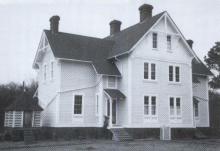
March 1, 1876 - The Italian Bark Ottarina struck this beach and went to pieces the next day. The crew of the L.S.S. station lost their lives attempting to rescue the crew (of this vessel). Nine of the crew were lost and four saved.
Nov. 26, 1877 - Some bodies from the wreck of the Huron came ashore near this station, more came on the 26 through the 29. The light keeper helped bury them.
Diamond Shoals Lighthouse: the lighthouse that never was
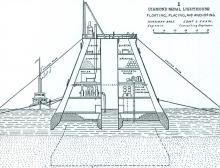
Cape Hatteras, North Carolina, is the elbow of an arm of low islands known as the "Outer Banks". This elbow pokes these barrier islands a good 25 miles into the Atlantic. Seven miles farther at sea are treacherous shifting underwater sand banks known as Diamond Shoals. In the days of sail the Diamond Shoals were one of the most feared spots of any ocean. The strong and wide Gulf Stream moving north at up to 4 knots from the Gulf of Mexico forced the south bound sailing ships to "go inside" or west of the stream to escape the current.